


Page 413 - The Book of Caterpillars: A Life-Size Guide to Six Hundred Species From Around the World
P. 413
MOTH CATERPILLARS

                      FAMILY  Saturniidae
                  DISTRIBUTION  West Africa, including Guinea, Ivory Coast, Sierra Leone,
                           and Togo
                     HABITAT  Tropical forest patches and savannah
                  HOST PLANTS  Unknown; in captivity has fed on Laurel Sumac (Malosma laurina)
                      NOTE  Yellow or black silkmoth caterpillar that is edible
             CONSERVATION STATUS  Not evaluated


                                                                                   ADULT WINGSPAN
                                                                                  2–2¾ in (50–70 mm)
                                                                                  CATERPILLAR LENGTH
                                                                                    2⅛ in (55 mm)
            MICRAGONE HERILLA
            MICRAGONE HERILLA                                                                    411

            WESTWOOD, 1849


            The Micragone herilla caterpillar can be seen inside its squarish,
            translucent yellow egg several days before it hatches. The  rst

            instar is pale yellow with a black head and is sparsely covered in

            sti , reddish hairs. In captivity, caterpillars have been observed
            feeding together on leaves of Laural Sumac, developing two
            totally distinct forms of colors and patterns by the third instar.

            At the end of the  fth instar, they had all spun a loose cocoon
            among debris above ground, with the first adult emerging
            six weeks later.


            Micragone herilla adults are sexually dimorphic. As in most
            species of giant silkmoth, the females are much larger than
            the males, enabling them to transport their heavy eggs
            while they search for a preferred host plant on which to place
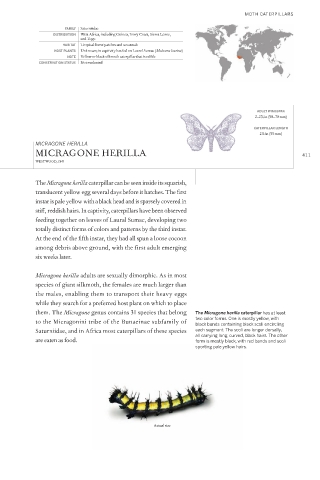
            them. The Micragone genus contains 31 species that belong   The Micragone herilla caterpillar has at least
            to the Micragonini tribe of the Bunaeinae subfamily of   two color forms. One is mostly yellow, with
                                                               black bands containing black scoli encircling
            Saturniidae, and in Africa most caterpillars of these species   each segment. The scoli are longer dorsally,
            are eaten as food.                                 all carrying long, curved, black hairs. The other
                                                               form is mostly black, with red bands and scoli
                                                               sporting pale yellow hairs.


                                                  Actual size

