


Page 414 - The Book of Caterpillars: A Life-Size Guide to Six Hundred Species From Around the World
P. 414
MOTH CATERPILLARS

                                                     FAMILY  Saturniidae
                                                 DISTRIBUTION  Eastern Mexico, south to northern Venezuela, Colombia,
                                                          and Ecuador west of the Andes
                                                    HABITAT  Forests and scrub, tropical to temperate
                                                  HOST PLANTS  Leguminous trees; in captivity has fed on Robinia spp.
                                                          and Acacia spp.
                                                      NOTE  Gregarious caterpillar whose appearance helps distinguish
                                                          it from similar species
                                             CONSERVATION STATUS  Not evaluated


            ADULT WINGSPAN
           2⅜–3  ⁄   in (60–94 mm)
           CATERPILLAR LENGTH
             2½ in (63 mm)
                                                                              MOLIPPA NIBASA
                                                                MOLIPPA NIBASA
    412
                                                                             MAASSEN & WEYDING, 1886


                                            When the tiny caterpillar of Molippa nibasa hatches from a

                                            brown-and-white egg, it is a greenish  esh color with a black
                                            head and translucent spines. After molting to the third instar,
                                            it is black with yellow bands of skin sprouting long, branching
                                            yellow spines and reddish legs and head. From the outset, the
                                            caterpillar is very social, feeding close together with its siblings.
                                            After about  ve weeks, it spins a papery cocoon covered by a leaf

                                            or debris in a hidden place.


                                            Molippa nibasa is a member of the Hemileucinae, the subfamily
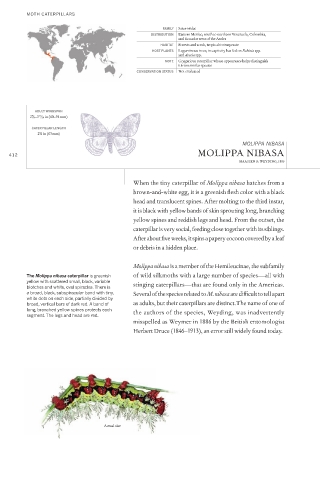
          The Molippa nibasa caterpillar is greenish   of wild silkmoths with a large number of species—all with
          yellow with scattered small, black, variable   stinging caterpillars—that are found only in the Americas.
          blotches and white, oval spiracles. There is


          a broad, black, subspiracular band with tiny,   Several of the species related to M. nibasa are di cult to tell apart
          white dots on each side, partially divided by
          broad, vertical bars of dark red. A band of   as adults, but their caterpillars are distinct.The name of one of
          long, branched yellow spines protects each   the authors of the species, Weyding, was inadvertently
          segment. The legs and head are red.
                                            misspelled as Weymer in 1886 by the British entomologist
                                            Herbert Druce (1846–1913), an error still widely found today.


                                  Actual size

