


Page 416 - The Book of Caterpillars: A Life-Size Guide to Six Hundred Species From Around the World
P. 416
MOTH CATERPILLARS

                                                     FAMILY  Saturniidae
                                                 DISTRIBUTION
                                                 DIS
                                                 DISTRIBUTION  Central Africa, south of the Sahara
                                                   TRIBUTION
                                                    HABITAT
                                                    HABIT
                                                       A
                                                    HABITAT T  Tropical forests and savannahs
                                                  HOS T PLANT S  Many, includingVernicia spp., Bauhinia spp., and Anacardium spp.
                                                  HOST PLANTS
                                                  HOST PLANTS
                                                      NO
                                                      NOTE  Spiny but edible caterpillar
                                                       TE
                                                      NOTE
                                             CONSERV A TION S T A TUS  Not evaluated
                                             CONSERVATION STATUS
                                             CONSERVATION STATUS
            ADULT WINGSPAN
             3½ in (90 mm)
           CATERPILLAR LENGTH
             2 ⁄   in (65 mm)
                                                                            NUDAURELIA DIONE
                                                             GOLDEN EMPEROR
    414
                                                                                   (FABRICIUS, 1793)


                                            The caterpillars of the Golden Emperor silkmoth are tiny
                                            and yellow when they hatch from their small group of white
                                            eggs early in the morning. During the day they move around
                                            searching for the best place to feed, then, just after dark, they line
                                            up side by side under the tip of a leaf and begin to eat. In later
                                            instars, they separate as their color transforms from yellow to
                                            black, with yellow markings. After the  fth instar, they burrow

                                            into the ground to pupate.


                                            Nudaurelia dione belongs to a large genus of African moths with
                                            46 species, but the Golden Emperor is one of the most common
                                            and widespread among them, occurring mainly within 15
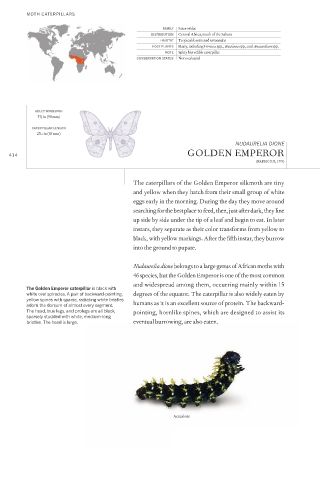
         The Golden Emperor caterpillar is black with
         white oval spiracles. A pair of backward-pointing,   degrees of the equator. The caterpillar is also widely eaten by
         yellow spines with sparse, radiating white bristles   humans as it is an excellent source of protein. The backward-
         adorn the dorsum of almost every segment.
         The head, true legs, and prolegs are all black,   pointing, hornlike spines, which are designed to assist its
         sparsely studded with white, medium-long
         bristles. The head is large.       eventual burrowing, are also eaten.


                                                        Actual size

