


Page 415 - The Book of Caterpillars: A Life-Size Guide to Six Hundred Species From Around the World
P. 415
MOTH CATERPILLARS

                      FAMILY  Saturniidae
                  DISTRIBUTION  From Turkey east across much of Asia
                     HABITAT  Mountains at 3,300–9,850 ft (1,000–3,000 m) elevation,
                           foothills, and orchards
                  HOST PLANTS  Spiraea (Spiraea spp.), pear (Pyrus spp.), ash (Fraxinus spp.),
                           willow (Salix spp.), and cherry (Prunus spp.)
                      NOTE  Tree-feeding, lethargic caterpillar that lives in cool climates
             CONSERVATION STATUS  Not evaluated


                                                                                   ADULT WINGSPAN
                                                                                  3⅛–4⅛ in (80–105 mm)
                                                                                  CATERPILLAR LENGTH
                                                                                    3⅛ in (80 mm)
            NEORIS HUTTONI
            NEORIS HUTTONI                                                                       413

            MOORE, 1862


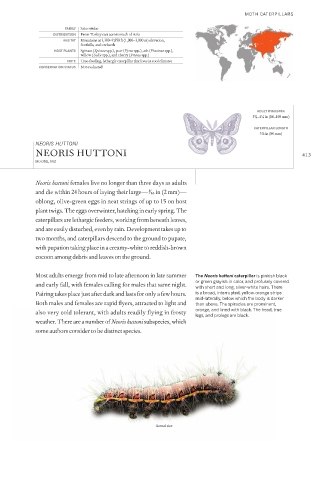
            Neoris huttoni females live no longer than three days as adults
            and die within 24 hours of laying their large— ⁄   in (2 mm)—
            oblong, olive-green eggs in neat strings of up to 15 on host
            plant twigs. The eggs overwinter, hatching in early spring. The
            caterpillars are lethargic feeders, working from beneath leaves,
            and are easily disturbed, even by rain. Development takes up to
            two months, and caterpillars descend to the ground to pupate,
            with pupation taking place in a creamy-white to reddish-brown
            cocoon among debris and leaves on the ground.


            Most adults emerge from mid to late afternoon in late summer   The Neoris huttoni caterpillar is pinkish black
            and early fall, with females calling for males that same night.   or green grayish in color, and profusely covered
                                                               with short and long, silver-white hairs. There
            Pairing takes place just after dark and lasts for only a few hours.   is a broad, interrupted, yellow-orange stripe
            Both males and females are rapid  yers, attracted to light and   mid-laterally, below which the body is darker

                                                               than above. The spiracles are prominent,
            also very cold tolerant, with adults readily flying in frosty   orange, and lined with black. The head, true
                                                               legs, and prolegs are black.
            weather. There are a number of Neoris huttoni subspecies, which
            some authors consider to be distinct species.


                                                   Actual size

