


Page 438 - The Book of Caterpillars: A Life-Size Guide to Six Hundred Species From Around the World
P. 438
MOTH CATERPILLARS

                                                     FAMILY  Sphingidae
                                                 DISTRIBUTION  Africa south of the Sahara, India, China, Japan, Southeast Asia,
                                                          and Australia
                                                    HABITAT  Urban parks and gardens, and lightly wooded areas


                                                  HOST PLANTS  Gardenia (Gardenia augusta), Co ee (Co ee arabica),
                                                          Wild Pomegranate (Burchellia bubaline), and Rhino Co ee

                                                          (Kraussia  oribunda)


                                                      NOTE  Well-camou aged, voracious, green caterpillar often found
                                                          in gardens
                                             CONSERVATION STATUS  Not evaluated, but generally common
            ADULT WINGSPAN
           1¾–2⅞ in (45–73 mm)
           CATERPILLAR LENGTH
           2⅛–2 ⁄   in (55–65 mm)
                                                                           CEPHONODES HYLAS
                                                   COFFEE BEE HAWKMOTH
    436
                                                                                   (LINNAEUS, 1771)


                                            Co ee Bee Hawkmoth caterpillars hatch from eggs laid singly

                                            on the underside of terminal host plant leaves, with the dark-

                                            colored  rst and second instars sporting a long, posterior horn.
                                            They feed alone and are sluggish but consume a great amount
                                            of leaf material. Older larvae, when disturbed, will throw
                                            their head back and eject green  uid from their mouth to repel

                                            potential predators. Final instar caterpillars wander and become
                                            brownish in color, making them less conspicuous as they travel


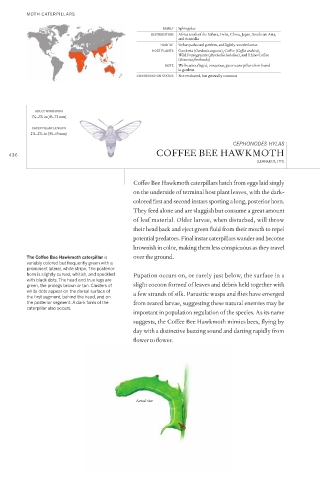
          The Co ee Bee Hawkmoth caterpillar is   over the ground.
          variably colored but frequently green with a
          prominent lateral, white stripe. The posterior
          horn is slightly curved, whitish, and speckled   Pupation occurs on, or rarely just below, the surface in a
          with black dots. The head and true legs are
          green, the prolegs brown or tan. Clusters of   slight cocoon formed of leaves and debris held together with
          white dots appear on the dorsal surface of   a few strands of silk. Parasitic wasps and   ies have emerged
          the   rst segment, behind the head, and on
          the posterior segment. A dark form of the   from reared larvae, suggesting these natural enemies may be
          caterpillar also occurs.
                                            important in population regulation of the species. As its name
                                            suggests, the Coffee Bee Hawkmoth mimics bees, flying by
                                            day with a distinctive buzzing sound and darting rapidly from
                                             ower to  ower.


                                            Actual size

