


Page 439 - The Book of Caterpillars: A Life-Size Guide to Six Hundred Species From Around the World
P. 439
MOTH CATERPILLARS

                      FAMILY  Sphingidae
                  DISTRIBUTION  India, China, Japan, Chinese Taipei, and Korea
                     HABITAT  Lowland forests, parks, and gardens
                  HOST PLANTS  Indian Beech (Millettia pinnata), Malabar Kino (Pterocarpus
                           marsupium), Soybean (Glycine max), ox-eye bean (Mucuna spp.),
                           and thorn tree (Acacia spp.)
                      NOTE  Caterpillars that are a delicacy in China
             CONSERVATION STATUS  Not evaluated, but generally common


                                                                                   ADULT WINGSPAN
                                                                                  3  ⁄  –6 in (94–150 mm)
                                                                                  CATERPILLAR LENGTH
            CLANIS BILINEATA                                                      3⅜–4 in (85–100 mm)
            TWO-LINED VELVET
            HAWKMOTH                                                                             437

            (WALKER, 1866)


            Two-lined Velvet Hawkmoth caterpillars hatch from smooth
            and shiny eggs laid singly on the underside of host plant leaves,
            where they hang, well camou aged, for much of the time. When

            resting, mature larvae raise the front part of their body with the
            head bowed and the true legs held together. Late-stage
            caterpillars are usually found quite high up, 10–20 ft (3–6 m),
            toward the ends of branches. Pupation takes place on the ground
            in a loosely spun cocoon, and there are multiple broods per
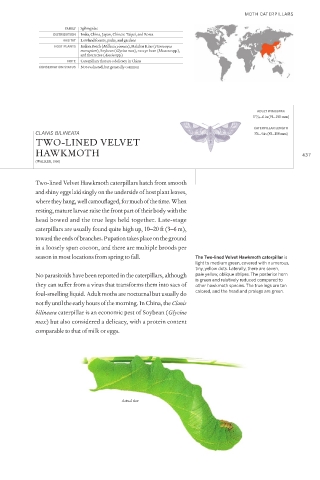
            season in most locations from spring to fall.      The Two-lined Velvet Hawkmoth caterpillar is
                                                               light to medium green, covered with numerous,
                                                               tiny, yellow dots. Laterally, there are seven,
            No parasitoids have been reported in the caterpillars, although   pale yellow, oblique stripes. The posterior horn
            they can su er from a virus that transforms them into sacs of   is green and relatively reduced compared to

                                                               other hawkmoth species. The true legs are tan
            foul-smelling liquid. Adult moths are nocturnal but usually do   colored, and the head and prolegs are green.
            not  y until the early hours of the morning. In China, the Clanis

            bilineata caterpillar is an economic pest of Soybean (Glycine
            max) but also considered a delicacy, with a protein content
            comparable to that of milk or eggs.


                                        Actual size

