


Page 440 - The Book of Caterpillars: A Life-Size Guide to Six Hundred Species From Around the World
P. 440
MOTH CATERPILLARS

                                                     FAMILY  Sphingidae
                                                 DISTRIBUTION  Africa, Madagascar, entire Mediterranean region, Middle East,
                                                          Afghanistan, India, southern China, Southeast Asia to the Malay
                                                          Peninsula, the Philippines, and Hawaii; also central Europe,
                                                          central Asia, and Japan as a migrant
                                                    HABITAT  Dry riverbeds, oases, and scrubby hillsides
                                                  HOST PLANTS  Wide range, including Oleander (Nerium oleander), grape
                                                          (Vitis spp.), and periwinkle (Vinca spp.)
                                                      NOTE  Striking caterpillar with eyespots and a horn to deter predators
                                             CONSERVATION STATUS  Not evaluated, but not threatened


            ADULT WINGSPAN
           3½–4¼ in (90–110 mm)
           CATERPILLAR LENGTH
           3–3⅜ in (75–85 mm)
                                                                                DAPHNIS NERII
                                                    OLEANDER HAWKMOTH
    438
                                                                                   (LINNAEUS, 1758)


                                            Oleander Hawkmoth caterpillars emerge from light green,
                                            round eggs, laid singly on young leaves up to 12 days earlier.
                                            Initially, the caterpillar is bright yellow green with a long, thin,
                                            black horn. It gradually changes to the apple green of the older
                                            caterpillar, and then becomes browner in color as it prepares to
                                            pupate on the ground among leaf litter. The pupa is light brown
                                            with tiny, dark brown spots, in a loosely spun, yellow cocoon.


                                            The species gets its common name from the caterpillar’s main
                                            food plant, the Oleander. Leaves of the Oleander contain toxins,
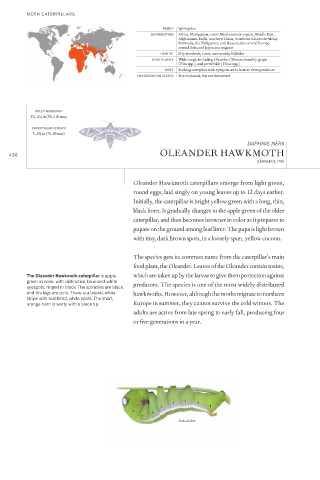
          The Oleander Hawkmoth caterpillar is apple   which are taken up by the larvae to give them protection against
          green in color, with distinctive, blue-and-white   predators. The species is one of the most widely distributed
          eyespots, ringed in black. The spiracles are black,
          and the legs are pink. There is a lateral, white   hawkmoths. However, although the moths migrate to northern
          stripe with scattered, white spots. The short,
          orange horn is warty with a black tip.  Europe in summer, they cannot survive the cold winters. The
                                            adults are active from late spring to early fall, producing four
                                            or  ve generations in a year.


                                                          Actual size

