


Page 441 - The Book of Caterpillars: A Life-Size Guide to Six Hundred Species From Around the World
P. 441
MOTH CATERPILLARS

                      FAMILY  Sphingidae
                  DISTRIBUTION  Temperate Europe across temperate west Asia and southern
                           Siberia to Russian Far East, Japan, and eastern and central China;
                           India (Sikkim, Assam), Nepal, Bhutan, and northern Myanmar;
                           also southern British Columbia (Canada) as an introduction

                     HABITAT  Ditches and river margins on  oodplains, damp forest clearings
                           and margins, even town wastelands, and damp meadows up to
                           4,920 ft (1,500 m) elevation in the Alps
                  HOST PLANTS  Herbaceous Onagraceae, especially Epilobium spp., and
                           Rubiaceae, often Galium spp.
                      NOTE  Alarming, snakelike caterpillar of attractive pink-and-khaki moth
             CONSERVATION STATUS  Not evaluated, but common, especially in warm, damp
                           riverine areas


                                                                                   ADULT WINGSPAN
                                                                                  2⅜–3 in (60–75 mm)
                                                                                  CATERPILLAR LENGTH
            DEILEPHILA ELPENOR                                                    2¾–3⅛ in (70–80 mm)
            LARGE ELEPHANT
            HAWKMOTH                                                                             439

            (LINNAEUS, 1758)


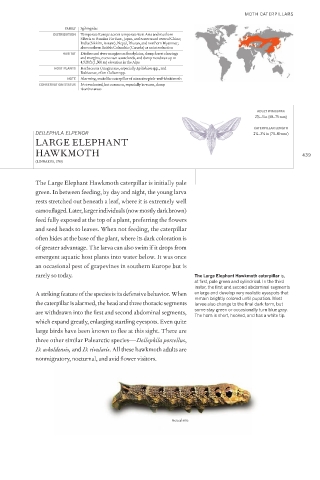
            The Large Elephant Hawkmoth caterpillar is initially pale
            green. In between feeding, by day and night, the young larva
            rests stretched out beneath a leaf, where it is extremely well

            camou aged. Later, larger individuals (now mostly dark brown)

            feed fully exposed at the top of a plant, preferring the  owers
            and seed heads to leaves. When not feeding, the caterpillar
            often hides at the base of the plant, where its dark coloration is
            of greater advantage. The larva can also swim if it drops from
            emergent aquatic host plants into water below. It was once
            an occasional pest of grapevines in southern Europe but is
            rarely so today.                                   The Large Elephant Hawkmoth caterpillar is,
                                                               at   rst, pale green and cylindrical. In the third
                                                               instar, the   rst and second abdominal segments
            A striking feature of the species is its defensive behavior. When   enlarge and develop very realistic eyespots that
            the caterpillar is alarmed, the head and three thoracic segments   remain brightly colored until pupation. Most
                                                               larvae also change to the   nal dark form, but
            are withdrawn into the  rst and second abdominal segments,   some stay green or occasionally turn blue gray.

                                                               The horn is short, hooked, and has a white tip.
            which expand greatly, enlarging startling eyespots. Even quite
            large birds have been known to flee at this sight. There are
            three other similar Palearctic species—Deilephila porcellus,
            D. askoldensis, and D. rivularis. All these hawkmoth adults are
            nonmigratory, nocturnal, and avid  ower visitors.


                                                        Actual size

