


Page 442 - The Book of Caterpillars: A Life-Size Guide to Six Hundred Species From Around the World
P. 442
MOTH CATERPILLARS

                                                     FAMILY  Sphingidae
                                                 DISTRIBUTION  Southern and Southeast Asia, from Pakistan east to southern
                                                          China and Vietnam
                                                    HABITAT  Higher elevation areas, parks, and gardens
                                                  HOST PLANTS  Privet (Ligustrum spp.), honeysuckle (Lonicera spp.), and
                                                          ash (Fraxinus spp.)
                                                      NOTE  “Sphinx” posturing caterpillar that may defoliate its host plant
                                             CONSERVATION STATUS  Not evaluated


            ADULT WINGSPAN
           2⅛–3⅜ in (55–86 mm)
           CATERPILLAR LENGTH
           2 ⁄  –2¾ in (52–70 mm)                                            DOLBINA INEXACTA
                                                           COMMON GRIZZLED
                                                                       HAWKMOTH
    440
                                                                                    (WALKER, 1856)


                                            Common Grizzled Hawkmoth caterpillars emerge from
                                            spherical, smooth, shiny green eggs laid by the female moth
                                            on the underside of host plant leaves. The larvae are not very
                                            active, preferring to move little but consume a great deal of
                                            vegetation during development, sometimes causing defoliation.
                                            The caterpillar spends much of its time resting on the underside
                                            of leaves in the typical “sphinx” posture, holding its head above
                                            its body. Prior to pupation, it stops feeding, loses its green color,
                                            and starts wandering, climbing to the ground in search of a
                                            suitable pupation site.


                                            Eventually, the caterpillar burrows about 6 in (150 mm) into
                                            the soil to form a chamber, where the pupa overwinters. The
                                            hawkmoth adults are nocturnal, feeding and egg laying at night.
                                            Like the caterpillars, the Dolbina inexacta adults are also well
                                            camou aged when at rest, blending in on tree trunks and other

                                            “grizzled” surfaces. One or two generations may occur annually.


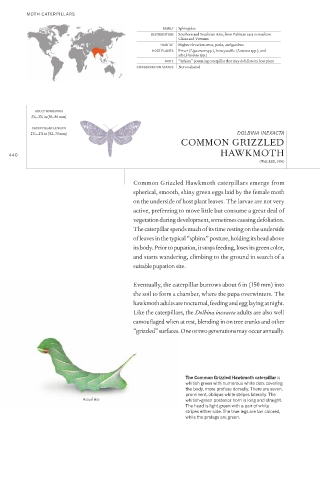
                                                            The Common Grizzled Hawkmoth caterpillar is
                                                            whitish green with numerous white dots covering
                                                            the body, more profuse dorsally. There are seven,
                                                            prominent, oblique white stripes laterally. The
                           Actual size                      whitish-green posterior horn is long and straight.
                                                            The head is light green with a pair of white
                                                            stripes either side. The true legs are tan colored,
                                                            while the prolegs are green.

