


Page 443 - The Book of Caterpillars: A Life-Size Guide to Six Hundred Species From Around the World
P. 443
MOTH CATERPILLARS

                      FAMILY  Sphingidae
                  DISTRIBUTION  Southern United States, Mexico, and South America
                     HABITAT  Forests and woods, parks, gardens, and dry hillsides
                  HOST PLANTS  Poinsettia (Euphorbia pulcherrima), other Euphorbia spp.,
                           Willow Bustic (Sideroxylon salicifolium), Sa ron Plum

                           (Bumelia celastrina), and Satinleaf (Chrysophyllum oliviforme)
                      NOTE  Subtropical, night-feeding caterpillar that is variably colored
             CONSERVATION STATUS  Not evaluated, but generally common


                                                                                   ADULT WINGSPAN
                                                                                  3–3 ⁄   in (76–88 mm)
                                                                                  CATERPILLAR LENGTH
                                                                                  1–1 ⁄   in (25–30 mm)
            ERINNYIS ELLO
            ELLO SPHINX MOTH                                                                     441

            (LINNAEUS, 1758)


            Ello Sphinx Moth caterpillars hatch from eggs laid on the leaves,
            stems, and even spines of the host plants. They are solitary in
            their, mainly nocturnal, feeding habits, and when inactive can
            be found along the midvein on the underside of leaves. The
            caterpillars have a slender posterior horn, which becomes
            progressively smaller as they mature, and their colors can
            vary from green to tan to purplish and brown. They are often
            parasitized by tachinid  ies and parasitic wasps.


            Pupation occurs in a loose cocoon of silk and debris in a shallow
            ground indentation. Adults, commonly found in early spring
            and the fall, emerge after about three weeks and are often

            seen feeding on periwinkle  owers. Females “call” males for
            mating by releasing pheromones from glands near the tip of
            their abdomen. There are one to three generations annually,
            depending on location and moisture.


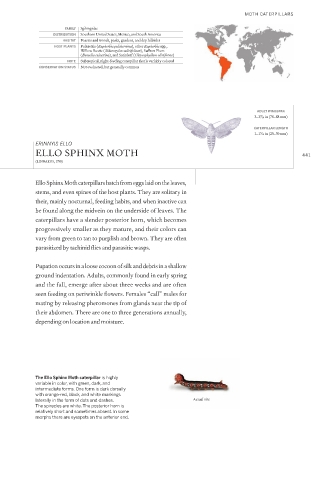
            The Ello Sphinx Moth caterpillar is highly
            variable in color, with green, dark, and
            intermediate forms. One form is dark dorsally
            with orange-red, black, and white markings
            laterally in the form of dots and dashes.          Actual size
            The spiracles are white. The posterior horn is
            relatively short and sometimes absent. In some
            morphs there are eyespots on the anterior end.

