


Page 444 - The Book of Caterpillars: A Life-Size Guide to Six Hundred Species From Around the World
P. 444
MOTH CATERPILLARS

                                                     FAMILY  Sphingidae
                                                 DISTRIBUTION
                                                 DIS TRIBUTION  Bolivia, Brazil, Paraguay, and Argentina
                                                 DISTRIBUTION
                                                    HABIT
                                                    HABITAT T  Forests
                                                    HABITAT
                                                       A
                                                  HOST PLANTS
                                                  HOST PLANTS
                                                  HOS T PLANT S  Grapevine (Vitis spp.)
                                                      NO
                                                      NOTE  Large, variably colored caterpillar that pupates underground
                                                       TE
                                                      NOTE
                                             CONSERVATION STATUS  Not evaluated, but generally common
                                             CONSERVATION STATUS
                                             CONSERV
                                                     T
                                                  TION S
                                                      A
                                                      TUS
                                                 A
            ADULT WINGSPAN
           3¾–5 in (95–130 mm)
           CATERPILLAR LENGTH
           3⅜–3¾ in (85–95 mm)
                                                                            EUMORPHA ANALIS
                                                            EUMORPHA ANALIS
    442
                                                                           (ROTHSCHILD & JORDAN, 1903)
                                            Eumorpha analis caterpillars, which specialize in feeding on
                                            plants in the grapevine family, come in a green and a dark form,
                                            like many hawkmoths, as well as many intermediate forms.
                                            Host plant quality is suspected to be a factor in determining
                                            the caterpillar color. Development is rapid, and the caterpillars
                                            consume a considerable amount of foliage. Pupation occurs a
                                            few inches below ground in an earthen cell, and just prior to
                                            adult emergence the pupa wriggles to the surface to allow the
                                            moth to escape the pupal case unimpeded.


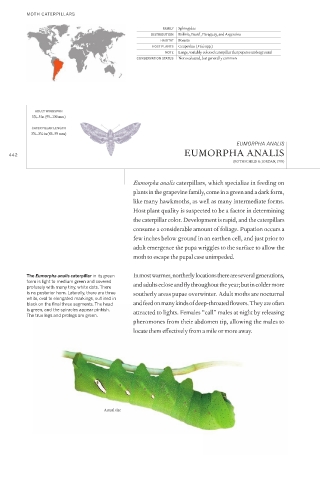
          The Eumorpha analis caterpillar in its green   In most warmer, northerly locations there are several generations,
          form is light to medium green and covered   and adults eclose and  y throughout the year; but in colder more

          profusely with many tiny, white dots. There
          is no posterior horn. Laterally, there are three   southerly areas pupae overwinter. Adult moths are nocturnal
          white, oval to elongated markings, outlined in

          black on the   nal three segments. The head   and feed on many kinds of deep-throated  owers. They are often
          is green, and the spiracles appear pinkish.   attracted to lights. Females “call” males at night by releasing
          The true legs and prolegs are green.
                                            pheromones from their abdomen tip, allowing the males to
                                            locate them e ectively from a mile or more away.


                                  Actual size

