


Page 445 - The Book of Caterpillars: A Life-Size Guide to Six Hundred Species From Around the World
P. 445
MOTH CATERPILLARS

                      FAMILY  Sphingidae
                  DISTRIBUTION  Southern Canada, United States, Central and South America,
                           and parts of the Caribbean
                     HABITAT  Rain forests, wet woodlands, and wetlands
                  HOST PLANTS  Various species in the evening primrose family (Onagraceae),
                           including Ludwigia spp.
                      NOTE  Variably colored caterpillar found in tropical forests and
                           temperate woodlands
             CONSERVATION STATUS  Not evaluated


                                                                                   ADULT WINGSPAN
                                                                                 3⅜–3  ⁄   in (85–97 mm)
                                                                                  CATERPILLAR LENGTH
                                                                                  2¾–3⅛ in (70–80 mm)
            EUMORPHA FASCIATUS
            BANDED SPHINX MOTH                                                                   443

            (SULZER, 1776)


            The caterpillars of the Banded Sphinx Moth, also known
            as the Lesser Vine Sphinx Moth, hatch from large, round eggs
            laid on the underside of leaves of the host plant. The larvae
            feed on the leaves, preferring the blade of the leaf either
            side of the midrib. They move to the ground to pupate in an
            underground chamber, overwintering there before wriggling
            to the surface just before eclosion.


            The moths appear at dusk and visit  owers to gather nectar. They
            are seen all year round in the tropics, where there are as many as
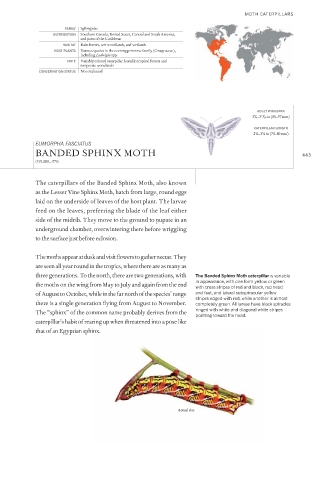
            three generations. To the north, there are two generations, with   The Banded Sphinx Moth caterpillar is variable
            the moths on the wing from May to July and again from the end   in appearance, with one form yellow or green
                                                               with cross stripes of red and black, red head
            of August to October, while in the far north of the species’ range   and feet, and lateral subspiracular yellow

            there is a single generation  ying from August to November.   stripes edged with red, while another is almost
                                                               completely green. All larvae have black spiracles
            The “sphinx” of the common name probably derives from the   ringed with white and diagonal white stripes
                                                               pointing toward the head.
            caterpillar’s habit of rearing up when threatened into a pose like
            that of an Egyptian sphinx.


                                                          Actual size

