


Page 446 - The Book of Caterpillars: A Life-Size Guide to Six Hundred Species From Around the World
P. 446
MOTH CATERPILLARS

                                                     FAMILY  Sphingidae
                                                 DISTRIBUTION  Nepal, northeastern India, Bangladesh, Myanmar, southern
                                                          China, Thailand, Vietnam, and Peninsular Malaysia
                                                    HABITAT  Forests, parks, and gardens
                                                  HOST PLANTS  Various, including Night-scented Lily (Alocasia odora),
                                                          elephant ear (Colocasia spp.), angel wings (Caladium spp.),
                                                          zaminkand (Amorphophallus spp.), Silver Vine (Scindapsus pictus),
                                                          and Arrowhead Plant (Syngonium podophyllum)
                                                      NOTE  Caterpillar that pretends to be a snake when disturbed
                                             CONSERVATION STATUS  Not evaluated, but generally common


            ADULT WINGSPAN
           2 ⁄  –2 ⁄   in (53–62 mm)
           CATERPILLAR LENGTH
           3⅜–3¾ in (85–95 mm)                                              EUPANACRA MYDON
                                                             COMMON RIPPLED
                                                                       HAWKMOTH
    444
                                                                                    (WALKER, 1856)


                                            The yellowish-green eggs of the Common Rippled Hawkmoth
                                            are laid singly on the leaves of host plants. Prior to hatching, the
                                            eggs turn orange, as the  rst instar, which is orange colored and

                                            with a long, posterior horn, becomes visible through the shell.
                                            The caterpillars consume a great deal of foliage, so development
                                            is rapid, taking little more than a month before pupation, with the
                                            pupae formed on or just under the ground. There are multiple
                                            generations annually, and adult moths feed nocturnally on a

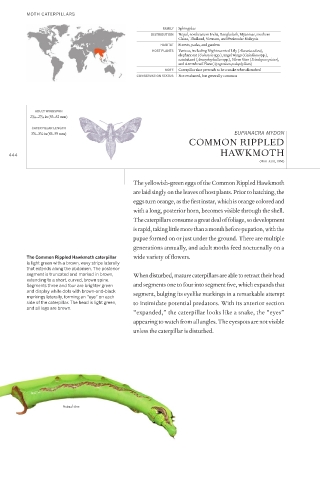
          The Common Rippled Hawkmoth caterpillar   wide variety of  owers.
          is light green with a brown, wavy stripe laterally
          that extends along the abdomen. The posterior
          segment is truncated and marked in brown,   When disturbed, mature caterpillars are able to retract their head
          extending to a short, curved, brown spine.

          Segments three and four are brighter green   and segments one to four into segment  ve, which expands that
          and display white dots with brown-and-black   segment, bulging its eyelike markings in a remarkable attempt
          markings laterally, forming an “eye” on each
          side of the caterpillar. The head is light green,   to intimidate potential predators. With its anterior section
          and all legs are brown.
                                            “expanded,” the caterpillar looks like a snake, the “eyes”
                                            appearing to watch from all angles. The eyespots are not visible
                                            unless the caterpillar is disturbed.


                     Actual size

