


Page 447 - The Book of Caterpillars: A Life-Size Guide to Six Hundred Species From Around the World
P. 447
MOTH CATERPILLARS

                      FAMILY  Sphingidae
                  DISTRIBUTION  Eastern Mongolia, Russian Far East, Japan, Korea,
                           and central and eastern China
                     HABITAT  Temperate woodland margins, tracks and clearings, leafy city
                           parks, and gardens
                  HOST PLANTS  Honeysuckle (Lonicera spp.), as well as snowberry
                           (Symphoricarpos spp.) in gardens
                      NOTE  Sphinxlike caterpillar that is well adapted to gardens and parks
             CONSERVATION STATUS  Not evaluated, but very common where honeysuckles
                           are prevalent


                                                                                   ADULT WINGSPAN
                                                                                 1  ⁄  –2⅛ in (43–54 mm)
                                                                                  CATERPILLAR LENGTH
            HEMARIS AFFINIS                                                       1 ⁄  –2 in (40–50 mm)
            HONEYSUCKLE BEE
            HAWKMOTH                                                                             445

            (BREMER, 1861)


            The Honeysuckle Bee Hawkmoth caterpillar rests initially
            along the midrib on the underside of a leaf, occasionally nibbling
            oval holes. Most larvae feed at night, resting during daylight in
            a typical sphinxlike pose. Full-grown caterpillars can be found
            under the terminal twigs of mid-level branches and are common
            around Beijing, China, on the ornamental Lonicera maackii from
            late August to October. If disturbed, most larvae will drop to the
            ground. The very dark brown, almost black pupa is formed in a
            loose brown cocoon among debris on the soil, and overwinters.


            This day-flying moth is a bumblebee mimic, flitting noisily
            like its namesake from  ower to  ower. In northern China there


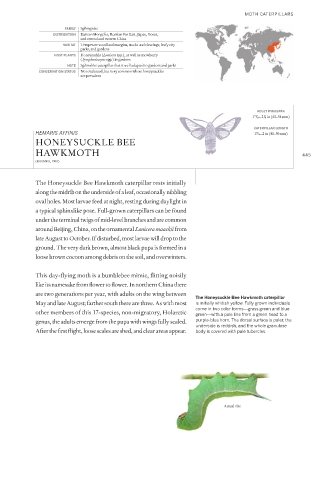
            are two generations per year, with adults on the wing between   The Honeysuckle Bee Hawkmoth caterpillar
            May and late August; farther south there are three. As with most   is initially whitish yellow. Fully grown individuals
            other members of this 17-species, non-migratory, Holarctic   come in two color forms—grass green and blue
                                                               green—with a pale line from a green head to a
            genus, the adults emerge from the pupa with wings fully scaled.   purple-blue horn. The dorsal surface is paler, the


            After the  rst  ight, loose scales are shed, and clear areas appear.  underside is reddish, and the whole granulose
                                                               body is covered with pale tubercles.


                                                                        Actual size

