


Page 451 - The Book of Caterpillars: A Life-Size Guide to Six Hundred Species From Around the World
P. 451
MOTH CATERPILLARS

                      FAMILY  Sphingidae
                  DISTRIBUTION  South America, including Argentina, Chile, Uruguay, Paraguay,
                           and Brazil
                     HABITAT  Savannahs and other open areas
                  HOST PLANTS  Wide range of plants in the families Fabaceae, Nyctaginaceae,
                           Onagraceae, Polygonaceae, Portulacaceae, and Solanaceae
                      NOTE  South American hawkmoth caterpillar that can be a grape pest
             CONSERVATION STATUS  Not evaluated, but generally uncommon


                                                                                   ADULT WINGSPAN
                                                                                  2 ⁄  –3⅛ in (65–80 mm)
                                                                                  CATERPILLAR LENGTH
                                                                                  3⅜–3½ in (85–90 mm)
            HYLES EUPHORBIARUM
            HYLES EUPHORBIARUM                                                                   449

            (GUÉRIN-MÉNEVILLE & PERCHERON, 1835)


            Hyles euphorbiarum caterpillars hatch from more than
            800 eggs laid singly on the host plants by the female moth.
            The first instar larvae are green but develop aposematic
            coloration in later instars—a warning to would-be predators of
            their distastefulness. The caterpillars feed openly on host plants
            and develop rapidly. Mature caterpillars pupate in an earthen cell
            a few inches below ground and form orangish-brown pupae.
            Before eclosion, the pupae wriggle their way to the soil surface.


            The adult moths, which  y throughout the year in most locations

            within their range, with the greatest numbers seen in March,
            July, September, and November, are primarily nocturnal,
            readily attracted to light, and visit many kinds of flowers.
            In some locations, caterpillars of this species cause economic
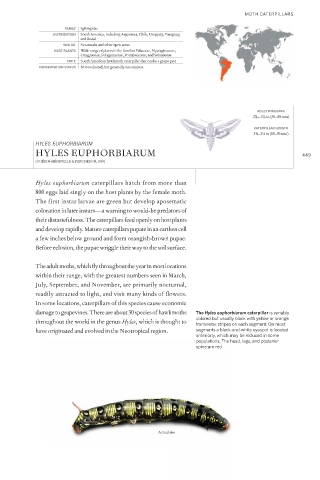
            damage to grapevines. There are about 30 species of hawkmoths   The Hyles euphorbiarum caterpillar is variably
            throughout the world in the genus Hyles, which is thought to   colored but usually black with yellow or orange
                                                                transverse stripes on each segment. On most
            have originated and evolved in the Neotropical region.  segments a black-and-white eyespot is located
                                                                anteriorly, which may be reduced in some
                                                                populations. The head, legs, and posterior
                                                                spine are red.


                                                   Actual size

