


Page 450 - The Book of Caterpillars: A Life-Size Guide to Six Hundred Species From Around the World
P. 450
MOTH CATERPILLARS

                                                     FAMILY  Sphingidae
                                                 DISTRIBUTION  Warm, temperate Europe and the Middle East to western
                                                          China and Mongolia; also areas of United States and Canada
                                                          as an introduction
                                                    HABITAT  Open, dry, sunny locations where Euphorbia spp. grow,
                                                          such as  eld and woodland edges, coastal sand dunes,

                                                          and bare mountainsides
                                                  HOST PLANTS  Herbaceous species of spurge (Euphorbia spp.), occasionally
                                                          Rumex spp. and Polygonum spp.
                                                      NOTE  Gaudy caterpillar that advertises its toxic nature
                                             CONSERVATION STATUS  Not evaluated, but common in hot, dry areas with plenty
                                                          of host plants


            ADULT WINGSPAN
           2¾–3⅜ in (70–85 mm)
           CATERPILLAR LENGTH
           2¾–3⅜ in (70–85 mm)
                                                                            HYLES EUPHORBIAE
                                                          SPURGE HAWKMOTH
    448
                                                                                   (LINNAEUS, 1758)


                                            Young Spurge Hawkmoth caterpillars rest low down on the host
                                            plant by day, moving up the stem en masse at dusk to feed. Full-
                                            grown larvae feed quite openly, relying on gaudy, aposematic
                                            coloration for protection. In all stages, larval feeding powers
                                            are prodigious. Vast quantities of leaves and soft stems are
                                            consumed between spells of basking, which the caterpillar does
                                            more frequently as it grows. If a larva is disturbed, a thick stream

                                            of dark green  uid is ejected from its mouth, accompanied by
                                            violent lateral body twitching. The green plant slurry is rich in
                                            potent, host-derived, toxins and irritants.


                                            The adult of this species is a noted migrant into central Europe
                                            and central Asia, where it can be confused with several resident
                                            species of Hyles, a widespread genus, containing up to
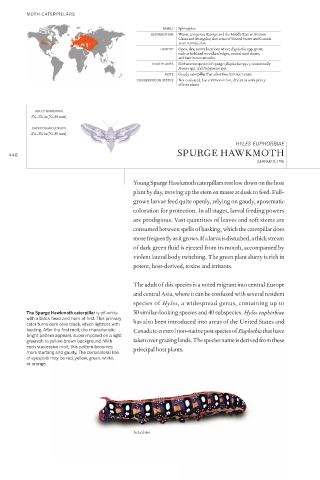
         The Spurge Hawkmoth caterpillar is o  -white   30 similar-looking species and 40 subspecies. Hyles euphorbiae
         with a black head and horn at   rst. This primary   has also been introduced into areas of the United States and
         color turns dark olive black, which lightens with
         feeding. After the   rst molt, the characteristic   Canada to control non-native pest species of Euphorbia that have
         bright pattern appears, superimposed on a light
         greenish to yellow-brown background. With   taken over grazing lands. The species name is derived from these
         each successive molt, this pattern becomes   principal host plants.
         more startling and gaudy. The dorsolateral line
         of eyespots may be red, yellow, green, white,
         or orange.


                                            Actual size

