


Page 452 - The Book of Caterpillars: A Life-Size Guide to Six Hundred Species From Around the World
P. 452
MOTH CATERPILLARS

                                                     FAMILY  Sphingidae
                                                   TRIBUTION
                                                 DISTRIBUTION  North America, Europe, central Asia, the Himalayas, and Japan
                                                 DIS
                                                 DISTRIBUTION
                                                    HABIT
                                                    HABITAT T  Meadows, forest edges, parks, and gardens
                                                    HABITAT
                                                       A
                                                  HOST PLANTS
                                                  HOS
                                                  HOST PLANTS S  Bedstraw (Galium spp.) and Fireweed (Epilobium angustifolium)
                                                    T PLANT
                                                      NO
                                                      NOTE  Red-horned caterpillar whose other coloring may vary
                                                       TE
                                                      NOTE
                                             CONSERVATION STATUS  Not evaluated, but not threatened
                                             CONSERVATION STATUS
                                             CONSERV
                                                     T
                                                  TION S
                                                      A
                                                      TUS
                                                 A
            ADULT WINGSPAN
           2    –3½ in (65–90 mm)
           CATERPILLAR LENGTH
           3–3⅜ in (75–85 mm)
                                                                                 HYLES GALLII
                                                    BEDSTRAW HAWKMOTH
    450
                                                                                 (ROTTEMBURG, 1775)
                                            The Bedstraw Hawkmoth female lays her small, almost round,
                                            blue-green eggs singly on the upper side of leaves and  owers,


                                            laying up to  ve eggs per plant. The newly hatched caterpillar is
                                            green with yellow lines and darkens with age. The eyespots and

                                            red horn help to scare o  predators. The caterpillars feed day
                                            and night and, at rest, they can be found lying along the midrib
                                            on the underside of a leaf. The older caterpillars crawl down the
                                            plant during the day and return at night to feed.


                                            The caterpillar pupates in leaf litter, where it spends the
                                            winter. The pupa is light brown and wrapped in a loosely spun,
                                            silken net, and the adult emerges in spring. Occasionally, there
                                            may be a second generation from adults that emerge early. The
                                            species is named for the caterpillar’s favorite food, bedstraw
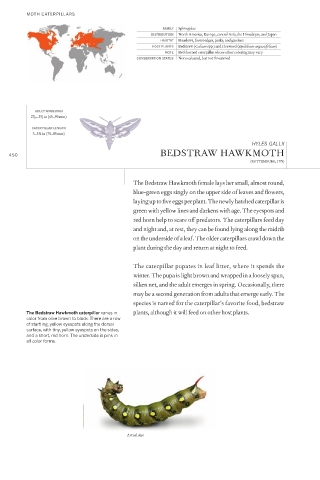
         The Bedstraw Hawkmoth caterpillar varies in   plants, although it will feed on other host plants.
         color from olive brown to black. There are a row
         of startling, yellow eyespots along the dorsal
         surface, with tiny, yellow eyespots on the sides,
         and a short, red horn. The underside is pink in
         all color forms.


                                          Actual size

