


Page 454 - The Book of Caterpillars: A Life-Size Guide to Six Hundred Species From Around the World
P. 454
MOTH CATERPILLARS

                                                     FAMILY  Sphingidae
                                                 DISTRIBUTION  From northwest Africa, southern Europe, and Asia Minor to
                                                          northern Pakistan and western Mongolia
                                                    HABITAT  Very sunny, dry, stony, mountainous hillsides with scattered
                                                          clumps of Euphorbia and little other vegetation; usually at high
                                                          altitude in Asia
                                                  HOST PLANTS  Herbaceous species of Euphorbia, particularly E. nicaeensis
                                                      NOTE  Huge, gaudy caterpillar of an elusive, local, and scarce species
                                             CONSERVATION STATUS  Not evaluated, but widespread


            ADULT WINGSPAN
           3⅛–4¼ in (80–110 mm)
           CATERPILLAR LENGTH
           4–4⅝ in (100–120 mm)                                                  HYLES NICAEA
                                                               GREATER SPURGE
                                                                       HAWKMOTH
    452
                                                                                 (DE PRUNNER, 1798)


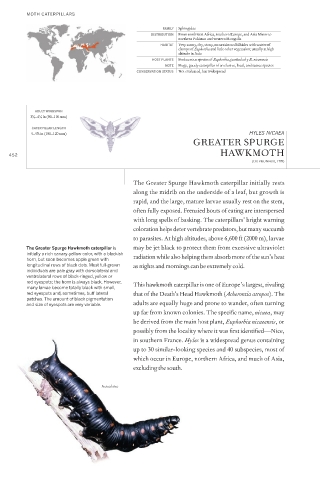
                                            The Greater Spurge Hawkmoth caterpillar initially rests
                                            along the midrib on the underside of a leaf, but growth is
                                            rapid, and the large, mature larvae usually rest on the stem,
                                            often fully exposed. Frenzied bouts of eating are interspersed
                                            with long spells of basking. The caterpillars’ bright warning
                                            coloration helps deter vertebrate predators, but many succumb
                                            to parasites. At high altitudes, above 6,600 ft (2000 m), larvae

         The Greater Spurge Hawkmoth caterpillar is   may be jet black to protect them from excessive ultraviolet
         initially a rich canary-yellow color, with a blackish   radiation while also helping them absorb more of the sun’s heat
         horn, but soon becomes apple green with
         longitudinal rows of black dots. Most full-grown   as nights and mornings can be extremely cold.
         individuals are pale gray with dorsolateral and
         ventrolateral rows of black-ringed, yellow or
         red eyespots; the horn is always black. However,   This hawkmoth caterpillar is one of Europe’s largest, rivaling
         many larvae become totally black with small,
         red eyespots and, sometimes, bu   lateral   that of the Death’s Head Hawkmoth (Acherontia atropos). The
         patches. The amount of black pigmentation
         and size of eyespots are very variable.  adults are equally huge and prone to wander, often turning

                                            up far from known colonies. The speci c name, nicaea, may
                                            be derived from the main host plant, Euphorbia nicaeensis, or
                                            possibly from the locality where it was  rst identi ed—Nice,


                                            in southern France. Hyles is a widespread genus containing
                                            up to 30 similar-looking species and 40 subspecies, most of
                                            which occur in Europe, northern Africa, and much of Asia,
                                            excluding the south.


                                 Actual size

