


Page 449 - The Book of Caterpillars: A Life-Size Guide to Six Hundred Species From Around the World
P. 449
MOTH CATERPILLARS

                      FAMILY  Sphingidae
                  DISTRIBUTION  Peru, Bolivia, Chile, and Argentina
                     HABITAT  Rangeland, xeric (dry) areas, gardens, and parks

                  HOST PLANTS  Willowherb (Epilobium spp.), four o’clock  ower (Mirabilis spp.),
                           evening primrose (Oenothera spp.), grapevine (Vitis spp.), tomato
                           (Lycopersicon spp.), purslane (Portulaca spp.), and Toothed Spurge
                           (Euphorbia dentate)
                      NOTE  Dramatically black caterpillar, that is sometimes a pest of grapes
             CONSERVATION STATUS  Not evaluated, but usually common


                                                                                   ADULT WINGSPAN
                                                                                  2⅜–2¾ in (60–70 mm)
                                                                                  CATERPILLAR LENGTH
                                                                                  2⅜–2¾ in (60–70 mm)
            HYLES ANNEI
            HYLES ANNEI                                                                          447

            (GUÉRIN-MÉNEVILLE, 1839)


            Hyles annei adult females lay glossy, green eggs singly on the
            leaves of their host plants. The caterpillars develop rapidly,
            taking about a month from egg hatch to pupation, with adults
            appearing a further three weeks later. Before the adults emerge
            from the pupal case, pupae wriggle their way to the soil surface
            to help e ect a successful exit. Females release a pheromone

            from the tip of their abdomen soon after emergence, which
            attracts males for mating. There are at least two generations
            a year in northern areas of the range but only one in the south.


            Occasionally, Hyles annei caterpillars can be an economic pest
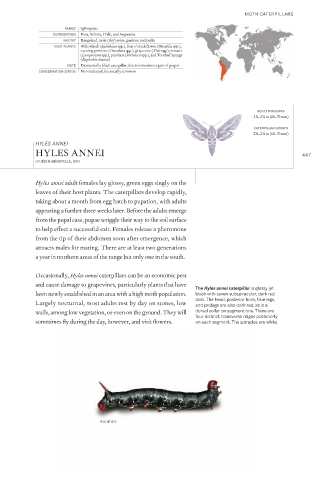
            and cause damage to grapevines, particularly plants that have   The Hyles annei caterpillar is glossy jet
            been newly established in an area with a high moth population.   black with seven subspiracular, dark red
            Largely nocturnal, most adults rest by day on stones, low   dots. The head, posterior horn, true legs,
                                                               and prolegs are also dark red, as is a
            walls, among low vegetation, or even on the ground. They will   dorsal collar on segment one. There are

            sometimes  y during the day, however, and visit  owers.  four distinct, transverse ridges posteriorly

                                                               on each segment. The spiracles are white.


                                 Actual size

