


Page 448 - The Book of Caterpillars: A Life-Size Guide to Six Hundred Species From Around the World
P. 448
MOTH CATERPILLARS

                                                     FAMILY  Sphingidae
                                                 DISTRIBUTION  Europe, tropical Africa, Egypt, India, Asia, and Australia
                                                    HABITAT  Wide-ranging, in gardens, parks, and open areas
                                                  HOST PLANTS  Many, including grapevine (Vitis spp.), Parthenocissus spp.,
                                                          Galium spp., Fuchsia spp., Epilobium spp., and Beta spp.
                                                      NOTE  Snake-mimicking caterpillar of a common migratory hawkmoth
                                             CONSERVATION STATUS  Not evaluated, but usually common


            ADULT WINGSPAN
           2⅜–3⅛ in (60–80 mm)
           CATERPILLAR LENGTH
           3⅛–3½ in (80–90 mm)
                                                                            HIPPOTION CELERIO
                                            SILVER-STRIPED HAWKMOTH
    446
                                                                                   (LINNAEUS, 1758)


                                            Silver-striped Hawkmoth females lay variably sized, glossy,
                                            bluish-green eggs singly on upper and lower surfaces of host
                                            plant leaves, usually near a growing tip. The eggs hatch after
                                             ve to ten days, depending on temperature, as green  rst instars


                                            with disproportionately long, black horns. The caterpillars are

                                            well camou aged on host plants and spend much time resting on
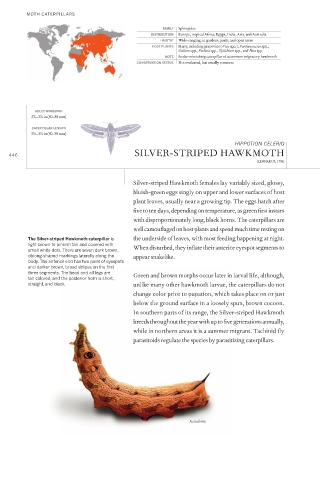
          The Silver-striped Hawkmoth caterpillar is   the underside of leaves, with most feeding happening at night.
          light brown to pinkish tan and covered with   When disturbed, they in ate their anterior eyespot segments to

          small white dots. There are seven dark brown,
          oblong-shaped markings laterally along the   appear snakelike.
          body. The anterior end has two pairs of eyespots
          and darker brown, broad stripes on the   rst
          three segments. The head and all legs are   Green and brown morphs occur later in larval life, although,
          tan colored, and the posterior horn is short,
          straight, and black.              unlike many other hawkmoth larvae, the caterpillars do not
                                            change color prior to pupation, which takes place on or just
                                            below the ground surface in a loosely spun, brown cocoon.
                                            In southern parts of its range, the Silver-striped Hawkmoth

                                            breeds throughout the year with up to  ve generations annually,
                                            while in northern areas it is a summer migrant. Tachinid fly
                                            parasitoids regulate the species by parasitizing caterpillars.


                                                             Actual size

