


Page 453 - The Book of Caterpillars: A Life-Size Guide to Six Hundred Species From Around the World
P. 453
MOTH CATERPILLARS

                      FAMILY  Sphingidae
                  DISTRIBUTION  North and South America, from southern Canada to
                           northern Argentina, and the Caribbean
                     HABITAT  Variety of habitats, including deserts and gardens
                  HOST PLANTS  Many, including apple (Malus spp.), Amaranthus spp.,
                           beets (Beta spp.), Brassica rapa, Lettuce (Lactuca sativa),
                           and Evening Primrose (Oenothera biennis)
                      NOTE  Polyphagous, abundant caterpillars formerly harvested
                           by Native Americans for food
             CONSERVATION STATUS  Not evaluated, but common


                                                                                   ADULT WINGSPAN
                                                                                  2 ⁄  –3½ in (62–90 mm)
                                                                                  CATERPILLAR LENGTH
                                                                                   3–4 in (76–100 mm)
            HYLES LINEATA
            WHITE-LINED SPHINX                                                                   451

            (FABRICIUS, 1775)


            White-lined Sphinx caterpillars can be extremely abundant;
            sometimes thousands are observed crawling on the ground in
            areas like the Arizona desert. The caterpillars are well adapted
            to a variety of habitats, being both polyphagous and also
            able to tolerate a remarkably wide range of temperatures—up
            to around 113°F (45°C)—changing their orientation on the
            host plant toward or away from a heat source to maintain a
            constant internal temperature. Mature larvae pupate in shallow
            burrows in the soil; adults eclose after two or three weeks and  y

            both by day and at dusk, hovering over  owers while drinking

            nectar. The species develops and breeds between February and
            November, producing two or more generations annually.


            Native Americans from the southwest United States consumed
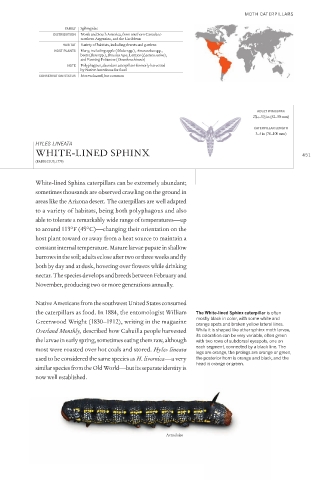
            the caterpillars as food. In 1884, the entomologist William   The White-lined Sphinx caterpillar is often
            Greenwood Wright (1830–1912), writing in the magazine   mostly black in color, with some white and
                                                                orange spots and broken yellow lateral lines.
            Overland Monthly, described how Cahuilla people harvested   While it is shaped like other sphinx moth larvae,
            the larvae in early spring, sometimes eating them raw, although   its coloration can be very variable, often green
                                                                with two rows of subdorsal eyespots, one on
            most were roasted over hot coals and stored. Hyles lineata   each segment, connected by a black line. The
                                                                legs are orange, the prolegs are orange or green,
            used to be considered the same species as H. livornica—a very   the posterior horn is orange and black, and the
            similar species from the Old World—but its separate identity is   head is orange or green.
            now well established.


                                                      Actual size

