


Page 457 - The Book of Caterpillars: A Life-Size Guide to Six Hundred Species From Around the World
P. 457
MOTH CATERPILLARS

                      FAMILY  Sphingidae
                  DISTRIBUTION  Areas of South and Southeast Asia, China, Korea, Japan,
                           and Hawaii
                     HABITAT  Forests, parks, gardens, and abandoned land
                  HOST PLANTS  Stinkvine (Paederia foetida) and Psychotria rubra
                      NOTE  Stout, green caterpillar that feeds on young leaves
             CONSERVATION STATUS  Not evaluated, but not threatened


                                                                                   ADULT WINGSPAN
                                                                                  1⅝–2
    in (42–56 mm)
                                                                                  CATERPILLAR LENGTH
                                                                                    2 in (50 mm)
            MACROGLOSSUM PYRRHOSTICTA
            MAILE PILAU HORNWORM                                                                 455

            BUTLER, 1875


            Maile Pilau Hornworms hatch from round, white eggs,
            which the adult female lays singly on the underside of young
            leaves. The young caterpillars are dark gray and have a shiny
            appearance. They feed on the youngest leaves and rest on the
            underside of leaves. The older larvae, which are apple green
            to bluish green in color, prefer to rest on the twining stems of
            the host plant. During the hotter summer months, they retreat
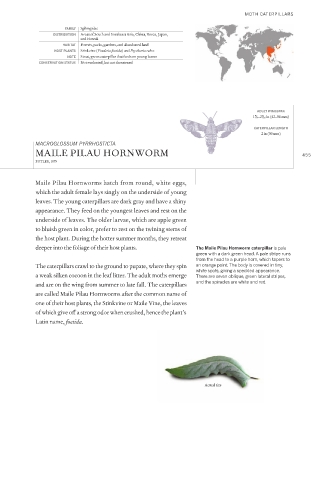
            deeper into the foliage of their host plants.       The Maile Pilau Hornworm caterpillar is pale
                                                                green with a dark green head. A pale stripe runs
                                                                from the head to a purple horn, which tapers to
            The caterpillars crawl to the ground to pupate, where they spin   an orange point. The body is covered in tiny,
            a weak silken cocoon in the leaf litter. The adult moths emerge   white spots, giving a speckled appearance.
                                                                There are seven oblique, green lateral stripes,
            and are on the wing from summer to late fall. The caterpillars   and the spiracles are white and red.
            are called Maile Pilau Hornworms after the common name of
            one of their host plants, the Stinkvine or Maile Vine, the leaves
            of which give o  a strong odor when crushed, hence the plant’s

            Latin name, foetida.


                                                                  Actual size

