


Page 459 - The Book of Caterpillars: A Life-Size Guide to Six Hundred Species From Around the World
P. 459
MOTH CATERPILLARS

                      FAMILY  Sphingidae
                  DISTRIBUTION  Southern Europe and North Africa, east across Asia to the east
                           coast of China and Japan; also in southern England as a resident
                           or migrant
                     HABITAT  Forest edges, parks, and gardens
                  HOST PLANTS  Bedstraw (Galium spp.) and madder (Rubia spp.)
                      NOTE  Caterpillar that may reach pupation in just 20 days
             CONSERVATION STATUS  Not evaluated, but not threatened


                                                                                   ADULT WINGSPAN
                                                                                  1    –1¾ in (40–45 mm)
                                                                                  CATERPILLAR LENGTH
                                                                                  2⅛–2⅜ in (55–60 mm)
            MACROGLOSSUM STELLATARUM
            HUMMINGBIRD HAWKMOTH                                                                 457

            (LINNAEUS, 1758)


            Hummingbird Hawkmoth caterpillars hatch from up to 200
            glossy green eggs, laid singly on separate plants by the female
            moth six to eight days earlier. The young larvae are initially
            yellow but become green from the second instar onward. Despite


            feeding on the top of the food plant, the larvae are di cult to spot

            thanks to their excellent camou age. Within a few weeks they
            move down to the lower stems of the host plant or the ground
            to pupate, spinning a cocoon among the leaves.

            There may be several generations a year. Since it is the adult that

            overwinters, few of the migrants that  y north survive the cold.
            Hummingbird Hawkmoths get their common name from their

            darting  ight and the way the moths hover like a hummingbird
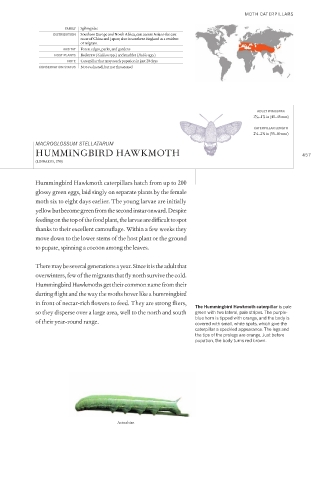
            in front of nectar-rich  owers to feed. They are strong  iers,   The Hummingbird Hawkmoth caterpillar is pale


            so they disperse over a large area, well to the north and south   green with two lateral, pale stripes. The purple-
            of their year-round range.                         blue horn is tipped with orange, and the body is
                                                               covered with small, white spots, which give the
                                                               caterpillar a speckled appearance. The legs and
                                                               the tips of the prolegs are orange. Just before
                                                               pupation, the body turns red brown.


                                      Actual size

