


Page 479 - The Book of Caterpillars: A Life-Size Guide to Six Hundred Species From Around the World
P. 479
MOTH CATERPILLARS

                      FAMILY  Sphingidae
                  DISTRIBUTION  Tropical and subtropical South Asia, east Asia, and Southeast Asia
                           to Australia, and north (as a migrant) to Russian Far East
                     HABITAT  Forest margins, open scrub, orchards, cultivated landscapes,
                           and suburban gardens
                  HOST PLANTS  Fuchsia spp., Sweet Potato (Ipomoea batatas), grapevine (Vitis
                           spp.), ornamental Busy Lizzie (Impatiens walleriana), Taro
                           (Colocasia esculenta), and many other species from the families
                           Araceae, Vitaceae, and Onagraceae
                      NOTE  Gaudy caterpillar that waves its horn as it walks
             CONSERVATION STATUS  Not evaluated, but very common and widespread


                                                                                   ADULT WINGSPAN
                                                                                  2⅛–3⅛ in (54–80 mm)
                                                                                  CATERPILLAR LENGTH
                                                                                  2⅜–3⅛ in (60–80 mm)
            THERETRA OLDENLANDIAE
            TARO HORNWORM                                                                        477

            (FABRICIUS, 1775)


            The Taro Hornworm hatches from pale green eggs laid singly
            on host plant leaves. It is initially a pale yellowish green but
            becomes darker by the second instar, and yellow-and-black
            eyespots appear on most segments. By the fourth instar its basic
            color is blackish, and it resembles the mature larva. Feeding
            mainly by day, the caterpillar prefers younger leaves, seedpods,
            and  ower heads, often stripping growing shoots, particularly


            in the  nal instar. It is an occasional pest of cultivated grapes and
            Sweet Potato. The larvae pupate in a loose cocoon among leaf
            litter; some pupae overwinter.


            There are one to two generations a year in northern China,
            with adults mainly in July and August. However, moths can be
            found between June and September over most of central and
            southern China, although it is probable that most are migrants.
            The adults, but not larvae, are easily confused with several
            other similar species, most notably Theretra margarita and
            T. silhetensis. The caterpillar’s common name is derived from
            Taro, one of its favorite tropical food plants.


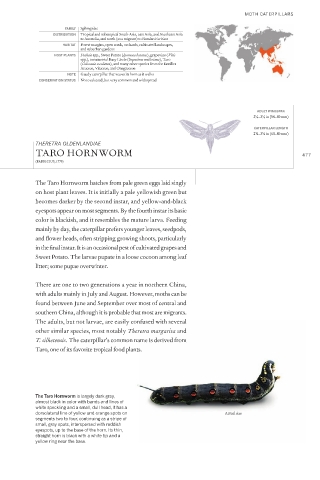
            The Taro Hornworm is largely dark gray,
            almost black in color with bands and lines of
            white speckling and a small, dull head, It has a
            dorsolateral line of yellow and orange spots on              Actual size
            segments two to four, continuing as a stripe of
            small, gray spots, interspersed with reddish
            eyespots, up to the base of the horn. Its thin,
            straight horn is black with a white tip and a
            yellow ring near the base.

