


Page 53 - The Book of Caterpillars: A Life-Size Guide to Six Hundred Species From Around the World
P. 53
BUTTERFLY CATERPILLARS

                      FAMILY  Papilionidae
                  DISTRIBUTION  Southern India and Sri Lanka, northeast India to southern
                           China, southern Japan, South Korea, and Southeast Asia
                           (Malay Peninsula, Indonesia, and the Philippines)
                     HABITAT  Open forests
                  HOST PLANTS  Members of Rutaceae, including Citrus spp., Euodia spp.,
                           Fortunella spp., Toddalia spp., and Zanthoxylum spp.
                      NOTE  Caterpillar that develops into a snake’s head look-alike
             CONSERVATION STATUS  Not evaluated, but very common


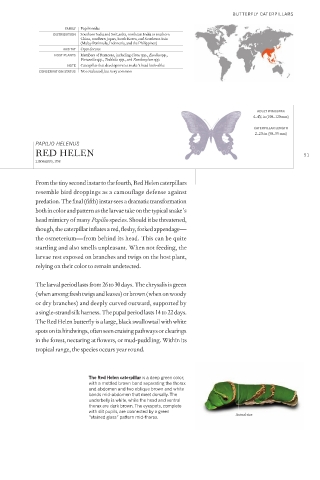
                                                                                   ADULT WINGSPAN
                                                                                  4–4⅝ in (100–120 mm)
                                                                                  CATERPILLAR LENGTH
                                                                                  2–2⅛ in (50–55 mm)
            PAPILIO HELENUS
            RED HELEN                                                                             51

            LINNAEUS, 1758


            From the tiny second instar to the fourth, Red Helen caterpillars
            resemble bird droppings as a camouflage defense against

            predation. The final (fifth) instar sees a dramatic transformation

            both in color and pattern as the larvae take on the typical snake’s
            head mimicry of many Papilio species. Should it be threatened,


            though, the caterpillar inflates a red, fleshy, forked appendage—
            the osmeterium—from behind its head. This can be quite
            startling and also smells unpleasant. When not feeding, the
            larvae rest exposed on branches and twigs on the host plant,
            relying on their color to remain undetected.


            The larval period lasts from 26 to 30 days. The chrysalis is green
            (when among fresh twigs and leaves) or brown (when on woody
            or dry branches) and deeply curved outward, supported by
            a single-strand silk harness. The pupal period lasts 14 to 22 days.
            The Red Helen butterfly is a large, black swallowtail with white

            spots on its hindwings, often seen cruising pathways or clearings

            in the forest, nectaring at flowers, or mud-puddling. Within its
            tropical range, the species occurs year round.


                             The Red Helen caterpillar is a deep green color,
                             with a mottled brown band separating the thorax
                             and abdomen and two oblique brown and white
                             bands mid-abdomen that meet dorsally. The
                             underbelly is white, while the head and ventral
                             thorax are dark brown. The eyespots, complete
                             with slit pupils, are connected by a green
                             “stained glass” pattern mid-thorax.            Actual size

