


Page 54 - The Book of Caterpillars: A Life-Size Guide to Six Hundred Species From Around the World
P. 54
BUTTERFLY CATERPILLARS

                                                     FAMILY  Papilionidae
                                                 DISTRIBUTION  South America, from eastern Brazil through Paraguay
                                                          and Uruguay to Argentina
                                                    HABITAT  Dry thorn scrub
                                                  HOST PLANTS  Berberis ruscifolia
                                                      NOTE  Eye-catching caterpillar that has distinctive green and
                                                          brown markings
                                             CONSERVATION STATUS  Not evaluated, but locally rare


            ADULT WINGSPAN
           2⅜–3½ in (60 –90 mm)
           CATERPILLAR LENGTH
              1¾–2⅛ in
              (45–55 mm)
                                                                          PAPILIO HELLANICHUS
                                                      PAPILIO HELLANICHUS
    52
                                                                                   HEWITSON, 1868


                                            The large Papilio hellanichus caterpillars live solitary lives
                                            on Berberis ruscifolia bushes. Their effective cryptic coloring

                                            helps them to blend with their surroundings, making it very


                                            difficult for predators to spot them. It is the only species of the
                                            Papilionidae that feeds on this plant species and, as a result, its
                                            distribution is limited to dry scrub where the host plant is found.
                                            There are two generations a year, although in wet years, many
                                            adults fail to emerge from their pupae, and sightings are rare.


                                            The adult butterfly, one of a number of Papilionidae species

                                            known as “swallowtails” for the forked appearance of their hind
                                            wings, is also susceptible to disturbance by humans, so it is only
                                            found in remote areas. Captive breeding could help boost its


                                            numbers, but this species has proved to be incredibly difficult to
                                            breed—largely because its food plant does not grow well away
                                            from its natural habitat, and the caterpillars are reluctant to feed
                                            on other plants.
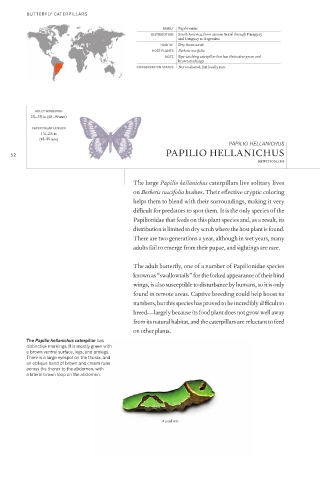
         The Papilio hellanichus caterpillar has
         distinctive markings. It is mostly green with
         a brown ventral surface, legs, and prolegs.
         There is a large eyespot on the thorax, and
         an oblique band of brown and cream runs
         across the thorax to the abdomen, with
         a lateral brown loop on the abdomen.


                                                     Actual size

