


Page 513 - The Book of Caterpillars: A Life-Size Guide to Six Hundred Species From Around the World
P. 513
MOTH CATERPILLARS

                      FAMILY  Notodontidae
                  DISTRIBUTION  North America, south from Quebec to Florida, west to Manitoba
                           and Texas
                     HABITAT  Fields, woodlands, and roadside edges
                  HOST PLANTS  Legumes (Fabaceae), including bush clover (Lespedeza spp.) and
                           locust tree (Gleditsia spp.)
                      NOTE  Brightly colored caterpillar that has a distinctive black spot
             CONSERVATION STATUS  Not evaluated, but rarely found in northern parts of its range


                                                                                   ADULT WINGSPAN
                                                                                  1 ⁄  –1⅝ in (30–41mm)
                                                                                  CATERPILLAR LENGTH
            DASYLOPHIA ANGUINA                                                      1 ⁄   in (40 mm)
            BLACK-SPOTTED
            PROMINENT                                                                            511

            (J. E. SMITH, 1797)


            The Black-spotted Prominent caterpillar is widely sought but
            seldom seen. In the eastern United States, it is most commonly
            encountered at high elevations by searching roadside locust
            trees. Inactive larvae are often found resting on the stems of
            young trees. When threatened, the caterpillar assumes the
            classic “prominent pose”—arching its back and posterior in
            an e ort to appear more intimidating to would-be predators.


            A distinguishing black spot on the dorsum is its most de ning
            characteristic. Its bright coloration suggests possible toxicity to
            predators. When fully developed, the larvae pupate in soil or
            leaf litter, and the pupae overwinter.


            The brownish adult moths, which are somewhat mundane in
            comparison to their colorful larvae,  y from April to September.

            A single brood of caterpillars typically peaks in late summer, but
            they can be found from May to November. The Dasylophia
            anguina caterpillar is similar in size and design to the more
            common Red-humped Oakworm (Symmerista canicosta),
            a ubiquitous oak feeder that shares its range.


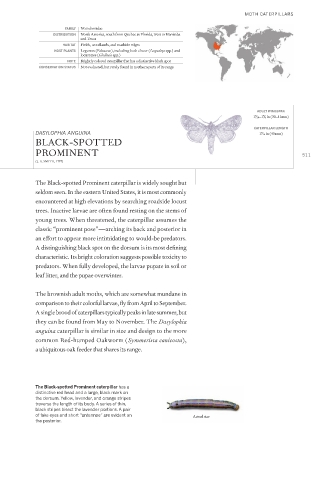
            The Black-spotted Prominent caterpillar has a
            distinctive red head and a large, black mark on
            the dorsum. Yellow, lavender, and orange stripes
            traverse the length of its body. A series of thin,
            black stripes bisect the lavender portions. A pair
            of fake eyes and short “antennae” are evident on   Actual size
            the posterior.

