


Page 514 - The Book of Caterpillars: A Life-Size Guide to Six Hundred Species From Around the World
P. 514
MOTH CATERPILLARS

                                                     FAMILY  Notodontidae
                                                 DISTRIBUTION  North America, from Quebec to Florida, west to Arkansas

                                                    HABITAT  Woodlands, barrens, and  eld edges
                                                  HOST PLANTS  Oak (Quercus spp.), chestnut (Castanea spp.), witch hazel
                                                          (Hamamelis spp.), and blueberry (Vaccinium spp.)
                                                      NOTE  Communal caterpillar that lives in dry woodlands
                                             CONSERVATION STATUS  Not evaluated, but not considered threatened


            ADULT WINGSPAN
           1½–2⅛ in (38–55 mm)
           CATERPILLAR LENGTH
             1¾ in (45 mm)
                                                                            DATANA CONTRACTA
                                                      CONTRACTED DATANA
    512
                                                                                     WALKER, 1855


                                            During its initial larval stage, the Contracted Datana caterpillar
                                            is yellow in color. Throughout a period of rapid growth, the
                                            overall appearance changes at successive instars, eventually
                                            culminating in its most recognizable, striped mature form. Like
                                            the larvae of all Datana species, this caterpillar is gregarious,
                                            typically observed feeding and resting in large groups. Young
                                            caterpillars skeletonize leaves, while mature caterpillars consume
                                            entire leaves, leaving the largest veins intact. Defoliation
                                            typically occurs one branch at a time.


                                            Nearing transformation, single caterpillars migrate away
                                            from the colony, eventually dropping from the tree to pupate
                                            beneath the soil. Adult moths usually emerge in July to mate
                                            and deposit single-layered clusters of eggs on the underside of
                                            leaves. Datana contracta caterpillars share many characteristics
                                            with D. ministra and other Datana species, both in appearance

                                            and behavior. Radcli e’s Dagger Moth (Acronicta radcli ei) is

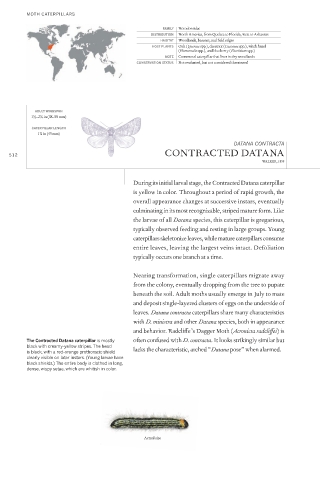
          The Contracted Datana caterpillar is mostly   often confused with D. contracta. It looks strikingly similar but
          black with creamy-yellow stripes. The head   lacks the characteristic, arched “Datana pose” when alarmed.
          is black, with a red-orange prothoracic shield
          clearly visible on later instars. (Young larvae have
          black shields.) The entire body is clothed in long,
          dense, wispy setae, which are whitish in color.


                                               Actual size

