


Page 515 - The Book of Caterpillars: A Life-Size Guide to Six Hundred Species From Around the World
P. 515
MOTH CATERPILLARS

                      FAMILY  Notodontidae
                  DISTRIBUTION  North America, from Nova Scotia to north Florida,
                           west to Kentucky
                     HABITAT  Deciduous woodlands
                  HOST PLANTS  Blueberry (Vaccinium spp.), linden (Tilia spp.), and witch hazel
                           (Hamamelis spp.)
                      NOTE  Gregariously feeding, aposematic caterpillar, that is striped
                           black and yellow
             CONSERVATION STATUS  Not evaluated, but common


                                                                                   ADULT WINGSPAN
                                                                                  1 ⁄  –2 ⁄   in (40–56 mm)
                                                                                  CATERPILLAR LENGTH
                                                                                  1¾–2 in (45–50 mm)
            DATANA DREXELII
            DREXEL’S DATANA                                                                      513

            HY. EDWARDS, 1884


            Drexel’s Datana caterpillars hatch from eggs laid in clusters on
            the leaves of their host plant. The young larvae are gregarious,
            feeding together and skeletonizing leaves when newly hatched.
            In later instars, the leaf is consumed in its entirety except for the
            midrib. When one branch is stripped, the caterpillars move en
            masse to another. In the  nal instar, the larvae descend to the

            ground to pupate, and the pupa overwinters. There is usually
            one generation a year in the north and two in the south of
            the species’ range.


            When disturbed, the larvae assume a characteristic posture
            with their rear and front raised. Later instars are colored
            aposematically, a clear signal to predators of unpalatability,
            amplified by their group feeding. In the final instar, Datana
            caterpillars also have a ventral gland that secretes various
            chemicals, which, unlike those in some other notodontid
            species, are not sprayed as a defense but may play some role
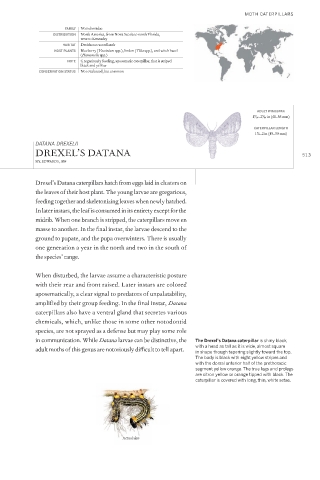
            in communication. While Datana larvae can be distinctive, the   The Drexel’s Datana caterpillar is shiny black,
            adult moths of this genus are notoriously di cult to tell apart.   with a head as tall as it is wide, almost square


                                                               in shape though tapering slightly toward the top.
                                                               The body is black with eight yellow stripes and
                                                               with the dorsal anterior half of the prothoracic
                                                               segment yellow orange. The true legs and prolegs
                                                               are citron yellow or orange tipped with black. The
                                                               caterpillar is covered with long, thin, white setae.


                                        Actual size

