


Page 517 - The Book of Caterpillars: A Life-Size Guide to Six Hundred Species From Around the World
P. 517
MOTH CATERPILLARS

                      FAMILY  Notodontidae
                  DISTRIBUTION  United States and southern Canada, east of the Rocky Mountains,
                           south to Florida; also California
                     HABITAT  Woodlands, parks, barrens, and orchards
                  HOST PLANTS  Oak (Quercus spp.), apple (Malus spp.), birch (Betula spp.),
                           basswood (Tilia spp.), willow (Salix spp.), and other woody trees
                      NOTE  Commonly encountered, showy caterpillar
             CONSERVATION STATUS  Not evaluated, but rated “globally secure” by the National
                           Center for Genome Resources, although declining in northeast
                           United States


                                                                                   ADULT WINGSPAN
                                                                                 1 ⁄  –2 ⁄   mm (40–53 mm)
                                                                                  CATERPILLAR LENGTH
            DATANA MINISTRA                                                       1¾–2 in (45–50 mm)
            YELLOWNECKED
            CATERPILLAR                                                                          515

            (DRURY, 1773)


            If encountered, the Yellownecked Caterpillar can exhibit some
            impressive showmanship. When threatened, it raises its head
            and tail portions, curling them backward dramatically over the
            dorsum. This static posture of defense, maintained long after
            the threat has ended, is a clearly recognizable characteristic
            of the Datana genus. The caterpillars are gregarious throughout
            the larval cycle, and are usually seen feeding and resting in tight
            groups. Young larvae skeletonize leaves. Mature caterpillars
            consume entire leaves, leaving only the thickest veins intact.


            Adult moths  y in June and July, the female laying masses of up
            to 100 white eggs, deposited on the underside of leaves. A single
            generation of caterpillars is typical, with a second brood more
            likely in the south of the range. Mature caterpillars burrow into
            the soil to overwinter as pupae. In the northeast of the species’
            range, a conspicuous decline in population has been attributed
            to the in ux of European parasitoids, which were imported to

            quell Gypsy Moth (Lymantria dispar) infestation.
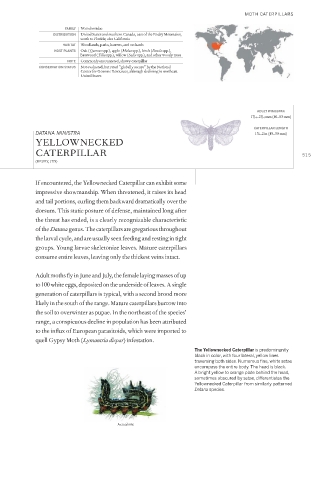
                                                               The Yellownecked Caterpillar is predominantly
                                                               black in color, with four lateral, yellow lines
                                                               traversing both sides. Numerous   ne, white setae
                                                               encompass the entire body. The head is black.
                                                               A bright yellow to orange plate behind the head,
                                                               sometimes obscured by setae, di  erentiates the
                                                               Yellownecked Caterpillar from similarly patterned
                                                               Datana species.


                                      Actual size

