


Page 516 - The Book of Caterpillars: A Life-Size Guide to Six Hundred Species From Around the World
P. 516
MOTH CATERPILLARS

                                                     FAMILY  Notodontidae
                                                 DISTRIBUTION  Southeast United States
                                                    HABITAT  Bogs and swamps
                                                  HOST PLANTS  Azalea (Rhododendron spp.) and Bog Rosemary
                                                          (Andromeda polifolia)
                                                      NOTE  Colorful caterpillar that has lateral yellow stripes
                                             CONSERVATION STATUS  Not evaluated


            ADULT WINGSPAN
           1 ⁄  –2 in (40–50 mm)
           CATERPILLAR LENGTH
             2 in (50 mm)
                                                                                DATANA MAJOR
                                                       AZALEA CATERPILLAR
    514
                                                                              GROTE & ROBINSON, 1866


                                            The Azalea Caterpillar hatches from a cluster of up to 100
                                            small, white eggs laid by the female moth on the underside of

                                            leaves. The  rst instars are gregarious and feed together. They
                                            have huge appetites and quickly skeletonize leaves. The older
                                            caterpillars eat whole leaves and can defoliate an entire plant.
                                            When disturbed, the larvae raise their front and rear ends and
                                            sometimes drop below the leaf, hanging on a silken thread.
                                            Initially, the caterpillars are yellow with seven, red, longitudinal
                                            stripes but gain color with each molt.


                                            After its  nal molt, the caterpillar crawls to the ground, where it

                                            pupates in the soil and overwinters. The moth adults are on the
                                            wing from June to August, with the caterpillars active from July
                                            to October. There is usually one generation a year, but there may
                                            be a partial second generation in the southern part of the range.


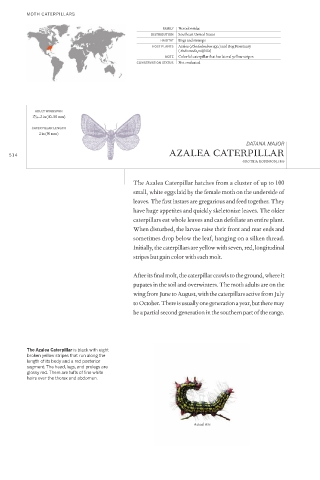
          The Azalea Caterpillar is black with eight
          broken yellow stripes that run along the
          length of its body and a red posterior
          segment. The head, legs, and prolegs are
          glossy red. There are tufts of   ne white
          hairs over the thorax and abdomen.


                                                               Actual size

