


Page 518 - The Book of Caterpillars: A Life-Size Guide to Six Hundred Species From Around the World
P. 518
MOTH CATERPILLARS

                                                     FAMILY  Notodontidae
                                                 DISTRIBUTION  Spain and southern France into central Europe, southern
                                                          Russia, and Turkey
                                                    HABITAT  Dry woodlands and scrub, riparian forests, dry grasslands,
                                                          and rocky slopes near wooded areas
                                                  HOST PLANTS  Elm (Ulmus spp.)

                                                      NOTE  Well-camou aged caterpillar that often frequents hot, dry places
                                             CONSERVATION STATUS  Not evaluated, but endangered in parts of its range


            ADULT WINGSPAN


           1⅜–1 ⁄   in (35–40 mm)
           CATERPILLAR LENGTH
             1 ⁄   in (40 mm)
                                                                              DICRANURA ULMI
                                                                          ELM MOTH
    516
                                                                         ([DENNIS & SCHIFFERMÜLLER], 1775)


                                            Elm Moth caterpillars emerge from white eggs that are laid
                                            singly on the upper surface of elm leaves. The larvae are seen
                                            on the leaves from May through to July, the young ones resting
                                            along the midrib on the underside of leaves, while the older ones
                                            rest along twigs, their cryptic coloration providing excellent

                                            camou age. The mature caterpillars move to the ground, where
                                            they pupate in a cocoon just under the surface of the soil. The
                                            species overwinters as a pupa and ecloses in spring.


                                            The night- ying moths are on the wing from March to May, and

                                            there is a single generation a year. Dicranura ulmi has disappeared
                                            from much of its former range and is currently at risk through
                                            the loss of its habitat, particularly hot, dry grassland, as a result
                                            of changes in agricultural management and industrial and tourist
                                            developments. Its numbers in southern Europe are more robust.


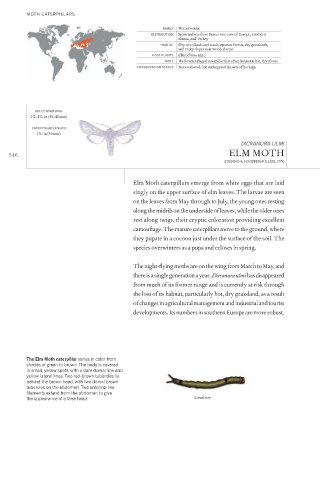
         The Elm Moth caterpillar varies in color from
         shades of green to brown. The body is covered
         in small, yellow spots, with a dark dorsal line and
         yellow lateral lines. Two red-brown tubercles lie
         behind the brown head, with two dorsal brown
         tubercles on the abdomen. Two antenna-like
           laments extend from the abdomen to give
         the appearance of a false head.                       Actual size

