


Page 519 - The Book of Caterpillars: A Life-Size Guide to Six Hundred Species From Around the World
P. 519
MOTH CATERPILLARS

                      FAMILY  Notodontidae
                  DISTRIBUTION  From western Europe and North Africa to the Urals, Asia Minor,
                           and the Caucasus
                     HABITAT  Forests, wooded hedgerows, parklands, and gardens
                  HOST PLANTS  Oak (Quercus spp.)
                      NOTE  One of the less conspicuous caterpillars of its family
             CONSERVATION STATUS  Not evaluated


                                                                                   ADULT WINGSPAN
                                                                                 1 ⁄  –1  ⁄   in (36–46 mm)
                                                                                  CATERPILLAR LENGTH


                                                                                  1⅜–1 ⁄   (35–40 mm)
            DRYMONIA RUFICORNIS
            LUNAR MARBLED BROWN                                                                  517
            (HUFNAGEL, 1766)


            Lunar Marbled Brown caterpillars hatch from rounded, light
            blue eggs laid in small groups on twigs or leaves from late March
            to early June. The larva is solitary and feeds until July, living
            openly without making a shelter, resting on the underside of a
            leaf, often high in the tree. When fully fed, it descends the tree
            and builds a cocoon on the ground close by, in which the stout,
            smooth, and shiny black pupa is formed and then overwinters.


            The Drymonia ruficornis caterpillar is well camouflaged
            on the underside of a leaf. Several related species, also on oak,
            have quite similar caterpillars but with a slightly different
            combination of features, usually with red in the stripe along the
            sides and more broken lines. The Marbled Brown (D. dodonaea),
            for instance, has a pair of broken lines close together along the
            middle of the back.


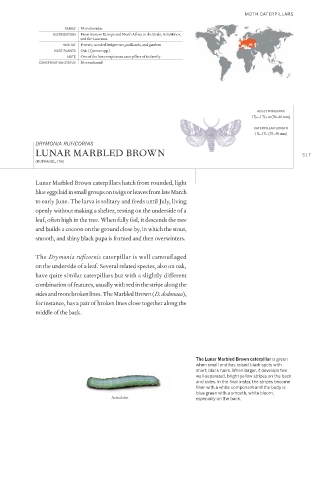
                                                                The Lunar Marbled Brown caterpillar is green
                                                                when small and has raised black spots with
                                                                short, black hairs. When larger, it develops two
                                                                well-separated, bright yellow stripes on the back
                                                                and sides. In the   nal instar, the stripes become
                                                                  ner with a white component and the body is
                                                                blue green with a smooth, white bloom,
                                     Actual size                especially on the back.

