


Page 520 - The Book of Caterpillars: A Life-Size Guide to Six Hundred Species From Around the World
P. 520
MOTH CATERPILLARS

                                                     FAMILY  Notodontidae
                                                 DISTRIBUTION  Northeast India, southern China, Chinese Taipei, and mainland
                                                          Southeast Asia
                                                    HABITAT  Lower-altitude montane forests
                                                  HOST PLANTS  Fagaceae, including chinkapin (Castanopsis spp.) and oak
                                                          (Quercus spp.)
                                                      NOTE  Caterpillar that has elaborate reticulate markings and
                                                          disruptive patterns
                                             CONSERVATION STATUS  Not evaluated, but not uncommon


            ADULT WINGSPAN
           1¾–2⅛ in (45–55 mm)
           CATERPILLAR LENGTH
             1¾ in (45 mm)
                                                                          FENTONIA BAIBARANA
                                                      FENTONIA BAIBARANA
    518
                                                                                  MATSUMURA, 1929


                                            The Fentonia baibarana caterpillar is unornamented and
                                            smooth with well-developed anal claspers, in contrast to other
                                            notodontid prominent moth larvae, which can be grotesquely
                                            shaped, with an absurd posture, and may lack the claspers. The
                                            F. baibarana larvae pupate in the soil in a loose, silken cocoon.
                      Actual size           The species has two or three generations during the spring and
                                            summer months, from April to the end of October, with the
                                             nal generation of the year overwintering as pupae to re-emerge

                                            around late March the following year.


                                            Although the caterpillars are intricately patterned with bold
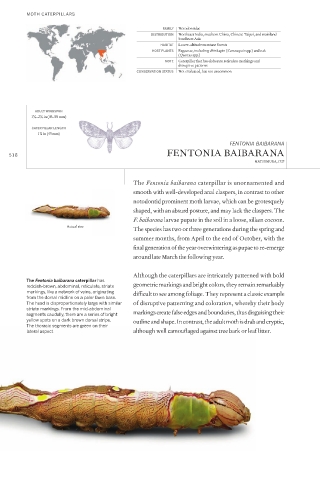
         The Fentonia baibarana caterpillar has
         reddish-brown, abdominal, reticulate, striate   geometric markings and bright colors, they remain remarkably
         markings, like a network of veins, originating   di cult to see among foliage. They represent a classic example


         from the dorsal midline on a paler fawn base.
         The head is disproportionately large with similar   of disruptive patterning and coloration, whereby their body
         striate markings. From the mid-abdominal   markings create false edges and boundaries, thus disguising their
         segments caudally, there are a series of bright
         yellow spots on a dark brown dorsal stripe.   outline and shape. In contrast, the adult moth is drab and cryptic,
         The thoracic segments are green on their

         lateral aspect.                    although well camou aged against tree bark or leaf litter.

