


Page 521 - The Book of Caterpillars: A Life-Size Guide to Six Hundred Species From Around the World
P. 521
MOTH CATERPILLARS

                      FAMILY  Notodontidae
                  DISTRIBUTION  Western Europe and North Africa east to the Urals and Asia
                           Minor, extending into southwest Russia and Kazakstan; also
                           Mongolia and Xinjiang province in northern China
                     HABITAT  Forests, hedgerows, parklands, and gardens
                  HOST PLANTS  Poplar (Populus spp.) and willow (Salix spp.)
                      NOTE  Caterpillar that has unusual hind appendages
             CONSERVATION STATUS  Not evaluated


                                                                                   ADULT WINGSPAN
                                                                                  1¾–1⅞ in (44–48 mm)
                                                                                  CATERPILLAR LENGTH
                                                                                  1 ⁄  –1½ in (34–38 mm)
            FURCULA BIFIDA
            POPLAR KITTEN                                                                        519

            (BRAHM, 1787)


            The Poplar Kitten caterpillar hatches from a black, hemispherical
            egg laid on the upper side of a leaf during the summer and
            feeds and rests among the leaves of its host plant. When fully
            developed, it pupates within a well-camou aged, hard, strong

            cocoon incorporating bark and wood and chewed slightly into
            a branch, trunk, or fence post. The pupa overwinters.            Actual size

            Adults and caterpillars of the genus Furcula (kitten moths)
            resemble those of the closely related but much larger moths of
            the genus Cerura (puss moths) and share very similar habits,
            forms, and life histories. The feline derivation arises in two
            ways. The pair of small protuberances behind the head of the
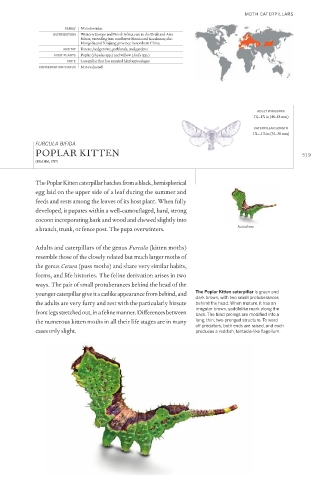
            younger caterpillar give it a catlike appearance from behind, and   The Poplar Kitten caterpillar is green and
                                                               dark brown, with two small protuberances
            the adults are very furry and rest with the particularly hirsute   behind the head. When mature, it has an
            front legs stretched out, in a feline manner. Di erences between   irregular brown, saddlelike mark along the

                                                               back. The hind prolegs are modi  ed into a
            the numerous kitten moths in all their life stages are in many   long, thin, two-pronged structure. To ward
            cases only slight.                                 o   predators, both ends are raised, and each
                                                               produces a reddish, tentacle-like   agellum.

