


Page 527 - The Book of Caterpillars: A Life-Size Guide to Six Hundred Species From Around the World
P. 527
MOTH CATERPILLARS

                      FAMILY  Notodontidae
                  DISTRIBUTION  Europe, western Asia
                     HABITAT  Wet woodlands and coppiced woodlands
                  HOST PLANTS  Various trees and bushes but mostly poplar (Populus spp.) and
                           willow (Salix spp.)
                      NOTE  Caterpillar whose distinctive appearance gives the species its name
             CONSERVATION STATUS  Not evaluated, but regionally endangered


                                                                                   ADULT WINGSPAN
                                                                                  1¾–2⅛ in (45–55 mm)
                                                                                  CATERPILLAR LENGTH
                                                                                    1 ⁄   in (30 mm)
            NOTODONTA TRITOPHUS
            THREE-HUMPED PROMINENT                                                               525

            (DENNIS & SCHIFFERMÜLLER, 1775)


            The Three-humped Prominent caterpillar has, as its name
            indicates, three rear-pointing humps on its back. Its strange
            appearance is further exaggerated when it raises its posterior
            end while feeding. After hatching from eggs laid on their host
            plant, the larvae are active from June to September, when they
            can be found feeding in the canopy of trees such as poplar and
            willow. The species overwinters as a pupa, and the adult moths
            are on the wing from April to August. There is usually a single
            generation, and in some places there may be two generations.


            This species, clearly named for its caterpillar, thrives in light
            woodland, where sunlight can reach the woodland floor.
            However, this type of habitat is in decline and under threat
            in some regions as a result of clearance and through neglect,
            as woodlands become less managed. Notodonta tritophus is
            sometimes classi ed as N. phoebe.


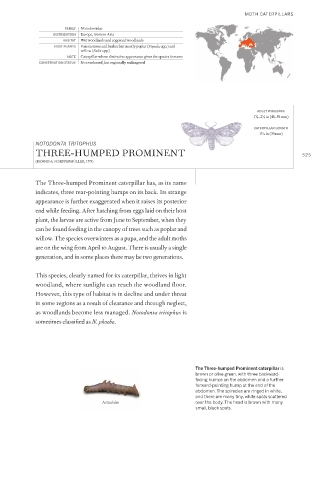
                                                               The Three-humped Prominent caterpillar is
                                                               brown or olive green, with three backward-
                                                               facing humps on the abdomen and a further
                                                               forward-pointing hump at the end of the
                                                               abdomen. The spiracles are ringed in white,
                                                               and there are many tiny, white spots scattered
                                  Actual size                  over the body. The head is brown with many
                                                               small, black spots.

