


Page 522 - The Book of Caterpillars: A Life-Size Guide to Six Hundred Species From Around the World
P. 522
MOTH CATERPILLARS

                                                     FAMILY  Notodontidae
                                                 DISTRIBUTION  Europe and into Asia
                                                    HABITAT  Wet woodlands, scrub, and heathlands
                                                  HOST PLANTS  Deciduous trees, including birch (Betula spp.), poplar (Populus spp.),
                                                          sallow (Salix caprea, Salix cinerea), and other willows (Salix spp.)
                                                      NOTE  Bright green caterpillar that has a long tail spur
                                             CONSERVATION STATUS  Not evaluated


            ADULT WINGSPAN


           1 ⁄  –1⅜ in (27–35 mm)
           CATERPILLAR LENGTH

             1⅜ in (35 mm)

                                                                             FURCULA FURCULA
                                                                SALLOW KITTEN
    520
                                                                                     (CLERK, 1759)

                                            Sallow Kitten caterpillars hatch from eggs laid in small groups
                                            on the surface of leaves, then feed on a range of trees and shrubs.
                                            When fully developed, the caterpillars make a tough cocoon
                                            by gnawing off bits of bark, which they intertwine with
                                            silk. The cocoon is securely  xed to a tree trunk or branch. The

                                            pupa overwinters, and the moth adults eclose the following
                                            spring. There is only one generation a year in the northern parts
                                            of the species’ range but usually a second generation in the south.


                                            Furcula furcula moths are on the wing from April until late
                                            August. The common name is derived from the appearance of
                                            the adult, which has a furry head and front legs, like a kitten.
                                            Though they tend to be smaller, Sallow Kitten larvae can
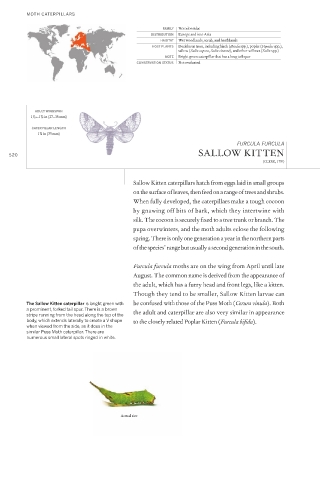
         The Sallow Kitten caterpillar is bright green with   be confused with those of the Puss Moth (Cerura vinula). Both
         a prominent, forked tail spur. There is a brown   the adult and caterpillar are also very similar in appearance
         stripe running from the head along the top of the

         body, which extends laterally to create a V shape   to the closely related Poplar Kitten (Furcula bi da).
         when viewed from the side, as it does in the
         similar Puss Moth caterpillar. There are
         numerous small lateral spots ringed in white.


                                        Actual size

