


Page 531 - The Book of Caterpillars: A Life-Size Guide to Six Hundred Species From Around the World
P. 531
MOTH CATERPILLARS

                      FAMILY  Notodontidae
                  DISTRIBUTION  Europe and across Asia to Russian Far East, China, and Japan
                     HABITAT  Forests, hedgerows, scrublands, parks, and gardens
                  HOST PLANTS  Many trees and shrubs, including oak (Quercus spp.), Hornbeam
                           (Carpinus betulus), lime (Tilia spp.), hazel (Corylus spp.), hawthorn
                           (Crataegus spp.), and rose (Rosa spp.)
                      NOTE  Caterpillar that throws its head backward when alarmed
             CONSERVATION STATUS  Not evaluated


                                                                                   ADULT WINGSPAN
                                                                                  1 ⁄  –2 in (37–50 mm)
                                                                                  CATERPILLAR LENGTH
                                                                                  1 ⁄  –1 ⁄   in (34–36 mm)
            PTILODON CAPUCINA
            COXCOMB PROMINENT                                                                    529

            (LINNAEUS, 1758)


            Coxcomb Prominent caterpillars hatch from whitish,
            hemispherical eggs laid in small groups on the leaves of their
            host plant. They can be found feeding, usually singly, in two
            generations from June to October, on tall trees as well as
            small bushes. When fully developed, the larvae descend to the
            ground to form the pupa on or under the surface in a cocoon that
            incorporates soil and debris. This stage overwinters.


            Notodontid caterpillars are highly varied in shape. When
            threatened, some raise the front and hind ends as a warning,
            and some have elaborate appendages that they raise and wave
            around. In this situation, the Coxcomb Prominent throws its
            head right back toward the red warts on the raised hind end, with
            the true legs held together, making it look spiky and less like a
            caterpillar. Other caterpillars, such as the Sprawler (Asteroscopus
            sphinx), a noctuid, can similarly throw back the head but without
            raising the hind end.


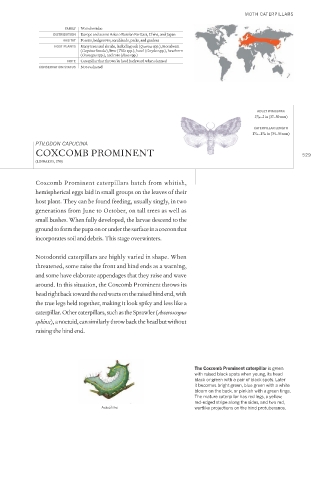
                                                               The Coxcomb Prominent caterpillar is green
                                                               with raised black spots when young, its head
                                                               black or green with a pair of black spots. Later
                                                               it becomes bright green, blue green with a white
                                                               bloom on the back, or pinkish with a green tinge.
                                                               The mature caterpillar has red legs, a yellow,
                                                               red-edged stripe along the sides, and two red,
                                 Actual size                   wartlike projections on the hind protuberance.

