


Page 524 - The Book of Caterpillars: A Life-Size Guide to Six Hundred Species From Around the World
P. 524
MOTH CATERPILLARS

                                                     FAMILY  Notodontidae
                                                 DIS
                                                   TRIBUTION
                                                 DISTRIBUTION  Across Europe, east to the Urals and Turkey
                                                 DISTRIBUTION
                                                    HABIT A T  Forests, woodlands, and parks
                                                    HABITAT
                                                    HABITAT
                                                  HOS T PLANT S  Beech (Fagus spp.) and oak (Quercus spp.)
                                                  HOST PLANTS
                                                  HOST PLANTS

                                                       TE
                                                      NOTE
                                                      NOTE  Strangely shaped caterpillar camou aged as part of a leaf
                                                      NO
                                             CONSERV A TION S T A TUS  Not evaluated, but is regionally endangered
                                             CONSERVATION STATUS
                                             CONSERVATION STATUS
            ADULT WINGSPAN
           1 ⁄  –2 ⁄   in (40–52 mm)
           CATERPILLAR LENGTH


           1⅜–1 ⁄   in (35–40 mm)
                                                                           HARPYIA MILHAUSERI
                                                          TAWNY PROMINENT
    522
                                                                                   (FABRICIUS, 1775)

                                            The caterpillars of the Tawny Prominent moth hatch from
                                            distinctive eggs laid on the underside of leaves in small clusters.
                                            Each egg, with its rings of brown, looks a little like an eyeball.
                                            The larvae feed on leaves, nibbling along the margins, and the
                                            mature caterpillar spins a cocoon of silk mixed with pieces of

                                            chewed wood to create a strong structure, which is  xed into
                                            a crack in the bark or occasionally on the ground. The species
                                            overwinters as a pupa and ecloses in spring.


                                            The moths are nocturnal and on the wing from May to June, and
                                            there is a single generation, with an occasional partial second
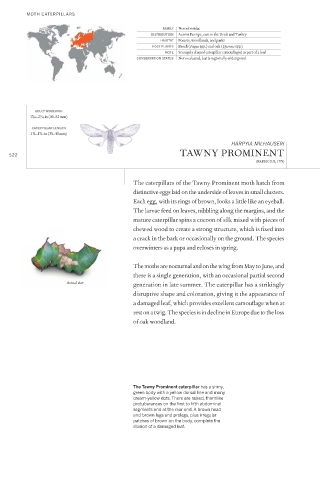
                      Actual size           generation in late summer. The caterpillar has a strikingly
                                            disruptive shape and coloration, giving it the appearance of
                                            a damaged leaf, which provides excellent camou age when at

                                            rest on a twig. The species is in decline in Europe due to the loss
                                            of oak woodland.


                                            The Tawny Prominent caterpillar has a shiny,
                                            green body with a yellow dorsal line and many
                                            cream-yellow dots. There are raised, thornlike
                                            protuberances on the   rst to   fth abdominal
                                            segments and at the rear end. A brown head
                                            and brown legs and prolegs, plus irregular
                                            patches of brown on the body, complete the
                                            illusion of a damaged leaf.

