


Page 529 - The Book of Caterpillars: A Life-Size Guide to Six Hundred Species From Around the World
P. 529
MOTH CATERPILLARS

                      FAMILY  Notodontidae
                  DISTRIBUTION  Eastern and western United States, southern Canada
                     HABITAT  Woodlands, forests, and roadside edges
                  HOST PLANTS  Oak (Quercus spp.), poplar (Populus spp.), willow (Salix spp.),
                           and other deciduous trees
                      NOTE  Foliage-mimicking caterpillar that feeds on leaf edges
             CONSERVATION STATUS  Not evaluated, but widespread and not threatened


                                                                                   ADULT WINGSPAN
                                                                                  1 ⁄  –1¾ in (30–45 mm)
                                                                                  CATERPILLAR LENGTH
                                                                                    1 ⁄   in (40 mm)
            OLIGOCENTRIA SEMIRUFESCENS
            RED-WASHED PROMINENT                                                                 527

            (WALKER, 1865)


            The Red-washed Prominent is often referred to as the
            “rhinoceros” caterpillar for its pronounced “horn,” which
            projects forward, sometimes extending beyond the head when
            at rest. Early instars feed by skeletonizing leaves from the top or
            bottom. The mature caterpillar, like similar prominent species,
            feeds along the leaf edges. It carves out a section of leaf material,
            then positions its body into the decimated cavity to create an
            illusion of dying leaf material. The coloration of larvae is

            variable to aid their ability to e ectively conceal themselves by
            blending into adjacent foliage.


            Two generations of mature caterpillars occur from June
            throughout the summer and early fall. Prepupal larvae
            overwinter in soil or leaf litter, and adult moths  y from May to

            September. The larva’s striking design is similar to two Schizura
            caterpillar species (S. unicornis and S. leptinoides), but it lacks
            de  ning Schizura characteristics, such as dark patches behind
            the head and green thoracic saddles.


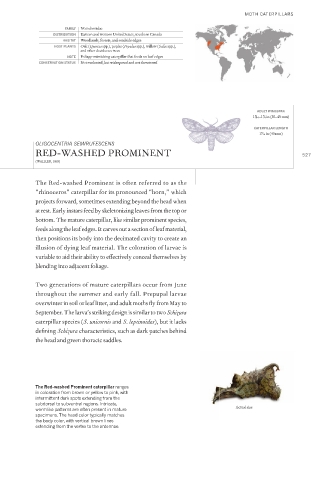
            The Red-washed Prominent caterpillar ranges
            in coloration from brown or yellow to pink, with
            intermittent dark spots extending from the
            subdorsal to subventral regions. Intricate,
            wormlike patterns are often present in mature                   Actual size
            specimens. The head color typically matches
            the body color, with vertical brown lines
            extending from the vertex to the antennae.

