


Page 523 - The Book of Caterpillars: A Life-Size Guide to Six Hundred Species From Around the World
P. 523
MOTH CATERPILLARS

                      FAMILY  Notodontidae
                  DISTRIBUTION  From Afghanistan southeast through northern India and Nepal to
                           southern China and Chinese Taipei, and Southeast Asia to Borneo
                     HABITAT  Low- and medium-altitude montane forests
                  HOST PLANTS  Various, including members of Fagaceae
                      NOTE  Caterpillar that has a cryptic body posture and multiple horns
             CONSERVATION STATUS  Not evaluated, but its life history is largely unknown


                                                                                   ADULT WINGSPAN
                                                                                  2–2 ⁄   in (50–62 mm)
                                                                                  CATERPILLAR LENGTH
                                                                                  1 ⁄  –1¾ in (40–45 mm)
            HARPYIA MICROSTICTA
            HARPYIA MICROSTICTA                                                                  521

            (SWINHOE, 1892)


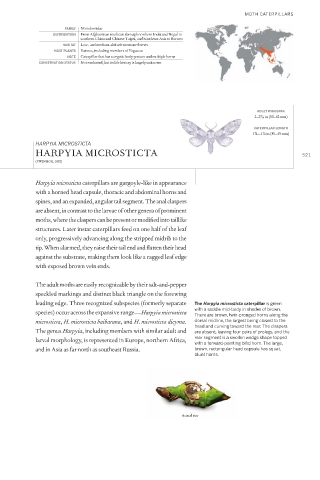
            Harpyia microsticta caterpillars are gargoyle-like in appearance
            with a horned head capsule, thoracic and abdominal horns and
            spines, and an expanded, angular tail segment. The anal claspers
            are absent, in contrast to the larvae of other genera of prominent
            moths, where the claspers can be present or modi ed into taillike

            structures. Later instar caterpillars feed on one half of the leaf
            only, progressively advancing along the stripped midrib to the

            tip. When alarmed, they raise their tail end and  atten their head
            against the substrate, making them look like a ragged leaf edge
            with exposed brown vein ends.


            The adult moths are easily recognizable by their salt-and-pepper
            speckled markings and distinct black triangle on the forewing
            leading edge. Three recognized subspecies (formerly separate   The Harpyia microsticta caterpillar is green
            species) occur across the expansive range—Harpyia microsticta   with a saddle mid-body in shades of brown.
                                                               There are brown, twin-pronged horns along the
            microsticta, H. microsticta baibarana, and H. microsticta dicyma.   dorsal midline, the largest being closest to the
            The genus Harpyia, including members with similar adult and   head and curving toward the rear. The claspers
                                                               are absent, leaving four pairs of prolegs, and the
            larval morphology, is represented in Europe, northern Africa,   rear segment is a swollen wedge shape topped
                                                               with a forward-pointing bi  d horn. The large,
            and in Asia as far north as southeast Russia.      brown, rectangular head capsule has squat,
                                                               blunt horns.


                                                           Actual size

