


Page 530 - The Book of Caterpillars: A Life-Size Guide to Six Hundred Species From Around the World
P. 530
MOTH CATERPILLARS

                                                     FAMILY  Notodontidae
                                                 DISTRIBUTION  Western Europe to the Urals, Turkey, and the Caucasus; also
                                                          western and southern Siberia (east to Lake Baikal), northwestern
                                                          Mongolia, and northwest China
                                                    HABITAT  Many habitats, including forests, wooded or scrubby wetland
                                                          margins, heathland, hedgerows, parks, and gardens
                                                  HOST PLANTS  Willow (Salix spp.) and poplar (Populus spp.)
                                                      NOTE  Common and rather distinctive green, sleek-looking caterpillar
                                             CONSERVATION STATUS  Not evaluated, but very common


            ADULT WINGSPAN
           1  ⁄  –2⅛ in (43–55 mm)
           CATERPILLAR LENGTH
           1½–1 ⁄   in (38–40 mm)
                                                                          PTEROSTOMA PALPINA
                                                               PALE PROMINENT
    528
                                                                                    (CLERCK, 1759)


                                            The Pale Prominent caterpillar hatches from a hemispherical,
                                            light green egg; the female moth lays her eggs in small groups
                                            on the underside of a leaf. The larvae can be found from June
                                            to September in two broods. They live and feed openly among
                                            the foliage of the tree or bush, where they are well camou aged.

                                            When fully developed, the caterpillars descend to the ground,
                                            where the dark brown, shiny pupa is formed in a cocoon on or
                                            slightly under the surface, near the base of the tree, covered with
                                            soil and debris.


                                            This is a very common species, with distinctive markings.
                                            Although green with white stripes is a popular livery among
                                            moth caterpillars, few if any species living on willow and poplar
                                            (at least in the Western Palearctic) possess the exact same
                                            combination of features as the Pale Prominent. The brownish
                                            adults  y in two broods, from April to September.


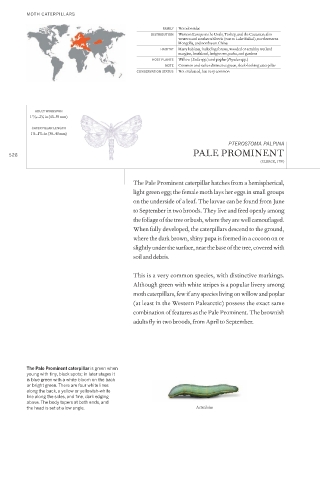
          The Pale Prominent caterpillar is green when
          young with tiny, black spots; in later stages it
          is blue green with a white bloom on the back
          or bright green. There are four white lines
          along the back, a yellow or yellowish-white
          line along the sides, and   ne, dark edging
          above. The body tapers at both ends, and
          the head is set at a low angle.                       Actual size

