


Page 525 - The Book of Caterpillars: A Life-Size Guide to Six Hundred Species From Around the World
P. 525
MOTH CATERPILLARS

                      FAMILY  Notodontidae
                  DISTRIBUTION  North America, from southeastern Canada to Florida,
                           west to Texas
                     HABITAT  Forests, woodlands, and roadside edges
                  HOST PLANTS  Woody trees, including basswood (Tilia spp.), oak (Quercus spp.),
                           beech (Fagus spp.), cherry (Prunus spp.), and witch hazel
                           (Hamamelis spp.)
                      NOTE  Notodontid prominent caterpillar commonly encountered in
                           eastern United States forests
             CONSERVATION STATUS  Not evaluated, but common in its range


                                                                                   ADULT WINGSPAN
                                                                                  1½–2 ⁄   in (38–56 mm)
                                                                                  CATERPILLAR LENGTH
                                                                                    1¾ in (45 mm)
            HETEROCAMPA BIUNDATA
            WAVY-LINED HETEROCAMPA                                                               523

            WALKER, 1855


            Like many “prominent” caterpillars, which are named for
            the protruding tuft of hair on the forewing of adults, the
            Wavy-lined Heterocampa prefers to feed and rest on leaf edges,
            where an effective camouflage helps it to hide in plain sight.
            Early instar larvae sport a pair of  eshy “antlers” behind the

            head. These defining appendages become fully manifested
            during the third instar. During the fourth and  fth ( nal) instars,


            the prothoracic growths are minimalized or nonexistent, as the
            caterpillar’s appearance becomes more bulbous and reddish
            prior to pupation. The prepupal caterpillar overwinters in soil

            or leaf litter, and the adult moth  ies from April to August.
                                                                              Actual size
            Heterocampa biundata shares its range with two similar species,
            H. obliqua, a specific oak feeder, and H. guttivitta, which is
            usually less vibrantly patterned. Two generations of mature
            larvae occur from May to November. Wavy-lined and other
            Heterocampa caterpillars are often found infested with the
            larvae of parasitic chalcid wasps, which deposit their eggs on
            the caterpillar’s skin, leaving the offspring to consume the
            caterpillar from within.


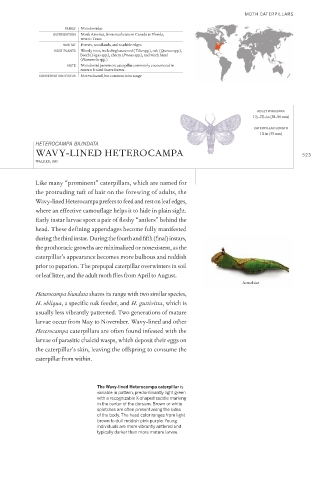
                                The Wavy-lined Heterocampa caterpillar is
                                variable in pattern, predominantly light green
                                with a recognizable X-shaped saddle marking
                                in the center of the dorsum. Brown or white
                                splotches are often present along the sides
                                of the body. The head color ranges from light
                                brown to dull reddish pink purple. Young
                                individuals are more vibrantly antlered and
                                typically darker than more mature larvae.

