


Page 526 - The Book of Caterpillars: A Life-Size Guide to Six Hundred Species From Around the World
P. 526
MOTH CATERPILLARS

                                                     FAMILY  Notodontidae
                                                 DISTRIBUTION  North America, from southern and southeastern Canada
                                                          to Florida, west to Texas
                                                    HABITAT  Fields, woodlands, and roadside edges
                                                  HOST PLANTS  Elm (Ulmus spp.)
                                                      NOTE  Caterpillar that mimics a leaf
                                             CONSERVATION STATUS  Not evaluated, but common throughout its range


            ADULT WINGSPAN
           1 ⁄  –1 ⁄   in (30–40 mm)
           CATERPILLAR LENGTH
             1 ⁄   in (40 mm)                                                NERICE BIDENTATA
                                                            DOUBLE-TOOTHED
                                                                        PROMINENT
    524
                                                                                     WALKER, 1855


                                            Double-toothed Prominent caterpillars hatch from eggs laid on
                                            their host plant from June onward, and are present into early
                                            November. The larvae are communal, so when one is found,
                                            a search of the surrounding elm foliage will likely yield many
                                            others. They are more often discovered on young sapling
                                            elms than on larger, more mature trees. Nature has provided
                                            the caterpillar with an effective deterrent against predation.
                                            Like many larvae that use disguise as defense, it is a master of
                                            mimicry, carving out a section of leaf, then positioning its resting
                                            body within the cavity to create a convincing new leaf edge.


                                            The pupa overwinters underground, and adult moths  y from
                                            April to September. Two generations are typical throughout
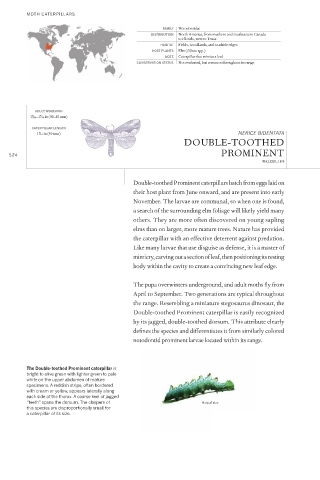
                                            the range. Resembling a miniature stegosaurus dinosaur, the
                                            Double-toothed Prominent caterpillar is easily recognized
                                            by its jagged, double-toothed dorsum. This attribute clearly


                                            de nes the species and di erentiates it from similarly colored
                                            notodontid prominent larvae located within its range.


          The Double-toothed Prominent caterpillar is
          bright to olive green with lighter green to pale
          white on the upper abdomen of mature
          specimens. A reddish stripe, often bordered
          with cream or yellow, appears laterally along
          each side of the thorax. A coarse keel of jagged
          “teeth” spans the dorsum. The claspers of              Actual size
          this species are disproportionally small for
          a caterpillar of its size.

