


Page 528 - The Book of Caterpillars: A Life-Size Guide to Six Hundred Species From Around the World
P. 528
MOTH CATERPILLARS

                                                     FAMILY  Notodontidae
                                                 DISTRIBUTION  Europe and North Africa to central Asia, east to China
                                                    HABITAT  Wet woodlands, coppiced woodlands, river valleys, and gardens
                                                  HOST PLANTS  Poplar (Populus spp.) and willow (Salix spp.)

                                                      NOTE  Camou aged caterpillar that raises its tail segment when feeding
                                             CONSERVATION STATUS  Not evaluated


            ADULT WINGSPAN
           1 ⁄  –1¾ in (40–45 mm)
           CATERPILLAR LENGTH
             1 ⁄   in (30 mm)
                                                                            NOTODONTA ZICZAC
                                                           PEBBLE PROMINENT
    526
                                                                                   (LINNAEUS, 1758)


                                            Pebble Prominent caterpillars hatch from round, white eggs laid
                                            singly on the leaves of poplar and willow in late spring. The
                                            caterpillars are active from June to early October. The young
                                            larvae feed on one side of the leaves, creating fenestrations,
                                            but the older caterpillars feed along the leaf margins. The
                                            caterpillars crawl to the ground, where they pupate in a loose
                                            cocoon underground. The pupa is red brown in color. The adult
                                            moths are on the wing from April to September, and there are
                                            often two generations.


                                            The caterpillar relies on camou age to avoid predation. The

                                             rst instar is green, but on molting it becomes brown and more

                                            twiglike. The characteristic humps that give rise to the species
                                            name appear in the later stages. At rest, the caterpillar hangs
                                            from the underside of a stem, raising the end of the abdomen
                                            and the head. Its genus name, Notodonta, means “back-tooth,”
                                            referring to the toothlike margin of the forewings.


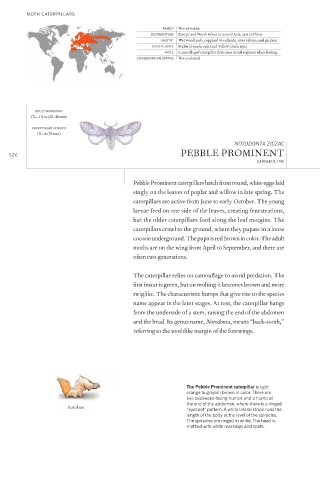
                                                             The Pebble Prominent caterpillar is light
                                                             orange to grayish brown in color. There are
                                                             two backward-facing humps and a hump at
                                                             the end of the abdomen, where there is a ringed
                       Actual size
                                                             “eyespot” pattern. A white lateral stripe runs the
                                                             length of the body at the level of the spiracles.
                                                             The spiracles are ringed in white. The head is
                                                             mottled with white markings and spots.

