


Page 533 - The Book of Caterpillars: A Life-Size Guide to Six Hundred Species From Around the World
P. 533
MOTH CATERPILLARS

                      FAMILY  Notodontidae
                    TRIBUTION
                  DISTRIBUTION  From the Pyrenees across the Alps to the Balkans
                  DIS
                  DISTRIBUTION
                     HABIT
                        A
                     HABITAT T  Scree and sheltered mountain valleys
                     HABITAT
                  HOST PLANTS S  Poplar (Populus spp.) and willow (Salix spp.)
                    T PLANT
                  HOST PLANTS
                  HOS
                      NO
                        TE
                      NOTE  Brown, hairy caterpillar that is found in alpine areas
                      NOTE
                       TUS
                      T
                  A
                   TION S
                       A
             CONSERVATION STATUS
             CONSERVATION STATUS  Not evaluated
             CONSERV
                                                                                   ADULT WINGSPAN
                                                                                    ⁄  –¾ in (18–20 mm)
                                                                                  CATERPILLAR LENGTH
                                                                                   ⁄  –¾ in (15–20 mm)
            RHEGMATOPHILA ALPINA
            ALPINE PROMINENT                                                                     531
            (BELLIER DE LA CHAVIGNERIE, 1881)
            The caterpillars of the Alpine Prominent moth hatch from eggs
            laid on leaves of poplar and willow. The dark brown colors of
            the caterpillar provide good camouflage when it rests along
            twigs and stems. The brown pupa overwinters and ecloses the
            following spring.

            The small, gray-brown moth is on the wing from May to
            September. There are usually two generations, although in the
            northerly parts of the range there may be just one. The moths
            are active at night, and during the day they rest on bark, where
            their gray-patterned wings blend perfectly with the background
            colors of the trees. The name Alpine Prominent comes from the
            projecting tuft of hair on the trailing edge of the forewing and
            the distribution of the species in alpine regions. The latter is also

            re ected in the scienti c name, alpina. The genus Rhegmatophila

            is small with just three species.


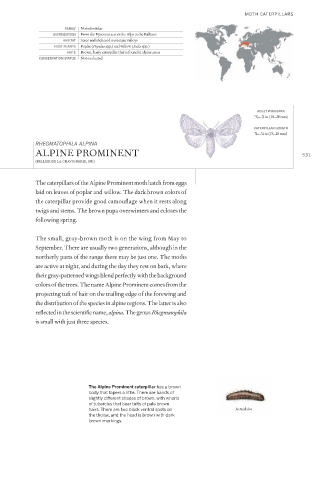
                             The Alpine Prominent caterpillar has a brown
                             body that tapers a little. There are bands of
                             slightly di  erent shades of brown, with whorls
                             of tubercles that bear tufts of pale brown
                             hairs. There are two black ventral spots on    Actual size
                             the thorax, and the head is brown with dark
                             brown markings.

