


Page 534 - The Book of Caterpillars: A Life-Size Guide to Six Hundred Species From Around the World
P. 534
MOTH CATERPILLARS

                                                     FAMILY  Notodontidae
                                                 DISTRIBUTION  North America, from southeastern Canada to Florida,
                                                          west to Texas
                                                    HABITAT  Fields, parks, and woodland forests
                                                  HOST PLANTS  Basswood (Tilia spp.), oak (Quercus spp.), beech (Fagus spp.),
                                                          blackberry (Rubus spp.), and morning glory (Ipomoeae spp.)
                                                      NOTE  Caterpillar that imitates a leaf
                                             CONSERVATION STATUS  Not evaluated, but considered secure within its range


            ADULT WINGSPAN
           1 ⁄  –1⅞ in (36–47 mm)
           CATERPILLAR LENGTH
             1 ⁄   in (40 mm)                                              SCHIZURA IPOMOEAE
                                                               MORNING GLORY
                                                                        PROMINENT
    532
                                                                                   DOUBLEDAY, 1841


                                            The Morning Glory Prominent caterpillar is a master of disguise.
                                            Like other Schizura species, the larva carves out a section of leaf
                                            material, then positions its body into the decimated cavity. This
                                            behavior allows the caterpillar to hide in plain sight, appearing to
                                            hungry birds and other predators as curled leaf material. A single
                                            brood of larvae is common in the north. Second generations
                                            have been documented in the south, with mature caterpillars
                                            existing from June throughout the summer and fall months.
                                            Schizura ipomoeae caterpillars are often found parasitized by
                                            braconid wasp larvae.


                                            This caterpillar’s species name is misleading as the larvae
                                            are more often found feeding on trees and shrubs other than
                                            morning glory. The Morning Glory Prominent caterpillar can
                                            be easily mistaken for the similarly shaped Unicorn Caterpillar
                                            (Schizura unicornis). Close examination of distinguishing head
                                            and dorsal markings is the best way to di erentiate between the

                                            two. Adult moths are nocturnal, and  y from April to September.


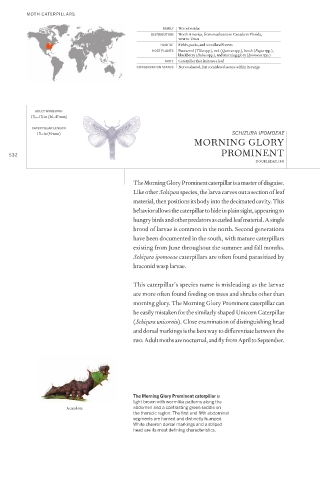
                                            The Morning Glory Prominent caterpillar is
                                            light brown with wormlike patterns along the
                      Actual size           abdomen and a contrasting green saddle on
                                            the thoracic region. The   rst and   fth abdominal
                                            segments are horned and distinctly humped.
                                            White chevron dorsal markings and a striped
                                            head are its most de  ning characteristics.

