


Page 57 - The Book of Caterpillars: A Life-Size Guide to Six Hundred Species From Around the World
P. 57
BUTTERFLY CATERPILLARS

                      FAMILY  Papilionidae
                    TRIBUTION
                  DISTRIBUTION
                  DISTRIBUTION  Borneo, the Philippines
                  DIS
                     HABIT
                     HABITAT T  Clearings in tropical rain forests
                     HABITAT
                        A
                  HOS
                  HOST PLANTS
                  HOST PLANTS S  Citrus spp.
                    T PLANT
                      NOTE
                      NO TE  Large caterpillar that in early stages resembles a bird dropping
                      NOTE
                       TUS
                      T
                       A
                   TION S
                  A
             CONSERVATION STATUS  Not evaluated
             CONSERV
             CONSERVATION STATUS
                                                                                   ADULT WINGSPAN
                                                                                 4½–4⅞ in (115–125 mm)
                                                                                  CATERPILLAR LENGTH
                                                                                  Up to 2⅜ in (60 mm)
            PAPILIO LOWII
            GREAT YELLOW MORMON                                                                   55
            DRUCE, 1873
            Great Yellow Mormon caterpillars hatch from creamy, yellow,
            round eggs with a roughened surface, which are laid singly by
            the female on the underside of host plant leaves. The newly
            hatched caterpillars feed first on the eggshell then on the leaves.

            When young, the larvae resemble bird droppings, which

            provides perfect camouflage. Mature caterpillars, with their two

            distinctive eyespots, look very different. When fully developed,
            the caterpillar pupates as a green chrysalis suspended from
            a stem by a silk girdle. There are several generations annually.


            The adults are on the wing in the canopy, only venturing lower
            in the forest to feed and to lay eggs. They are variable in
            appearance and very similar to the Great Mormon (Papilio
            memnon), which also has variable markings; in some
            classifi cations, P. lowii is considered a subspecies of P. memnon.
            Confusingly, the species is also sometimes known as the Asian
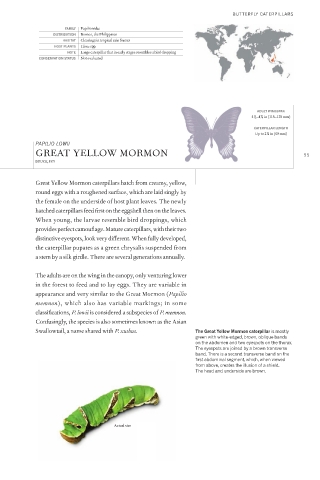
            Swallowtail, a name shared with P. xuthus.         The Great Yellow Mormon caterpillar is mostly
                                                               green with white-edged, brown, oblique bands
                                                               on the abdomen and two eyespots on the thorax.
                                                               The eyespots are joined by a brown transverse
                                                               band. There is a second transverse band on the
                                                                 rst abdominal segment, which, when viewed
                                                               from above, creates the illusion of a shield.
                                                               The head and underside are brown.


                                     Actual size

