


Page 56 - The Book of Caterpillars: A Life-Size Guide to Six Hundred Species From Around the World
P. 56
BUTTERFLY CATERPILLARS

                                                     FAMILY  Papilionidae
                                                 DIS TRIBUTION  Western North America, from British Columbia to Arizona
                                                 DISTRIBUTION
                                                 DISTRIBUTION
                                                    HABITAT
                                                    HABITAT T  Hilltops, rocky slopes, canyons, riverbanks, and roadsides
                                                       A
                                                    HABIT
                                                  HOST PLANTS S  Desert parsley (Lomatium spp.)
                                                  HOST PLANTS
                                                  HOS
                                                    T PLANT
                                                      NOTE
                                                      NOTE
                                                      NO TE  Caterpillar that grows fast on short-lived host plants
                                             CONSERV A TION S T A TUS  Not evaluated, but common
                                             CONSERVATION STATUS
                                             CONSERVATION STATUS
            ADULT WINGSPAN
           2⅜–2⁹∕₁₆ in (60–65 mm)
           CATERPILLAR LENGTH
           1⁹∕₁₆–2 in (40–50 mm)
                                                                                PAPILIO INDRA
                                                       INDRA SWALLOWTAIL
    54
                                                                                     REAKIRT, 1866


                                            Indra Swallowtail caterpillars hatch in late spring from eggs laid
                                            singly on desert parsleys up to a week earlier. The first instar

                                            consumes its eggshell and develops rapidly, pupating within
                                            20 to 30 days, according to temperature. Most growth occurs in
                                            the final instar, when the caterpillar doubles in size. The larvae

                                            come in two color forms—banded or black. Banded caterpillars
                                            tend to rest openly, whereas black caterpillars rest concealed
                                            within the foliage. Bold-banding in some individuals may serve
                                            as a real or false indication of distastefulness.


                                            Rapid development as caterpillars is critical to this species as
                                            its host plants senesce quickly in late spring and early summer.

                                            There are usually five instars but sometimes only four under
                                            hot, dry conditions. The pupae oversummer and overwinter,

                                            spending 11 to 12 months in this stage. Male butterflies are more
                                            often seen than females, which tend to stay on the upper reaches

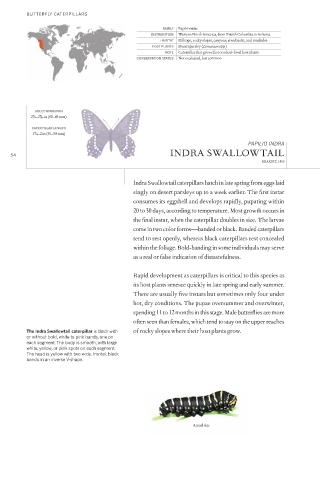
          The Indra Swallowtail caterpillar is black with   of rocky slopes where their host plants grow.
          or without bold, white to pink bands, one on
          each segment. The body is smooth, with large
          white, yellow, or pink spots on each segment.
          The head is yellow with two wide, frontal, black
          bands in an inverse V-shape.


                                                               Actual size

