


Page 55 - The Book of Caterpillars: A Life-Size Guide to Six Hundred Species From Around the World
P. 55
BUTTERFLY CATERPILLARS
FAMILY Papilionidae
DISTRIBUTION Corsica, Sardinia
HABITAT Grassy slopes with low-growing trees and shrubs up to
4,920 ft (1,500 m) elevation
HOST PLANTS Umbelliferae, including Corsican Rue (Ruta corsica),
Giant Fennel (Ferula communis), and Peucedanum paniculatum
NOTE Striking green and black caterpillar that has an orange osmeterium
CONSERVATION STATUS Least concern, with an increasing population
ADULT WINGSPAN
2⁄–3 in (72–76 mm)
CATERPILLAR LENGTH
1⁄ in (40 mm)
PAPILIO HOSPITON
CORSICAN SWALLOWTAIL 53
GENÉ, 1839
Corsican Swallowtail caterpillars hatch from eggs laid singly on
leaves of the host. They feed on the leaves and then overwinter
as pupae on the ground on rocks, wood, or stems. There is one
generation a year, with a possible partial second generation.
Corsican adults are on the wing in July, while the Sardinian
population flies earlier in May. The males show hilltopping
behavior while they await the arrival of the females.
The Corsican Swallowtail is endemic to just two islands, Corsica
and Sardinia, where it is protected and subject to various
conservation measures. For example, it is listed in Appendix 1
of CITES, which makes the collection and trade in the species
illegal. The species has been threatened by local farmers burning
the host plants, which are poisonous to livestock, but in recent
years habitat protection and management measures, such as
controlled fires to remove overgrown scrub and open up the
habitat, have resulted in a population increase. The caterpillar
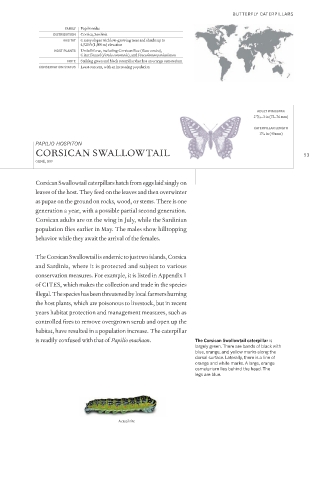
is readily confused with that of Papilio machaon. The Corsican Swallowtail caterpillar is
largely green. There are bands of black with
blue, orange, and yellow marks along the
dorsal surface. Laterally, there is a line of
orange and white marks. A large, orange
osmeterium lies behind the head. The
legs are blue.
Actual size

